


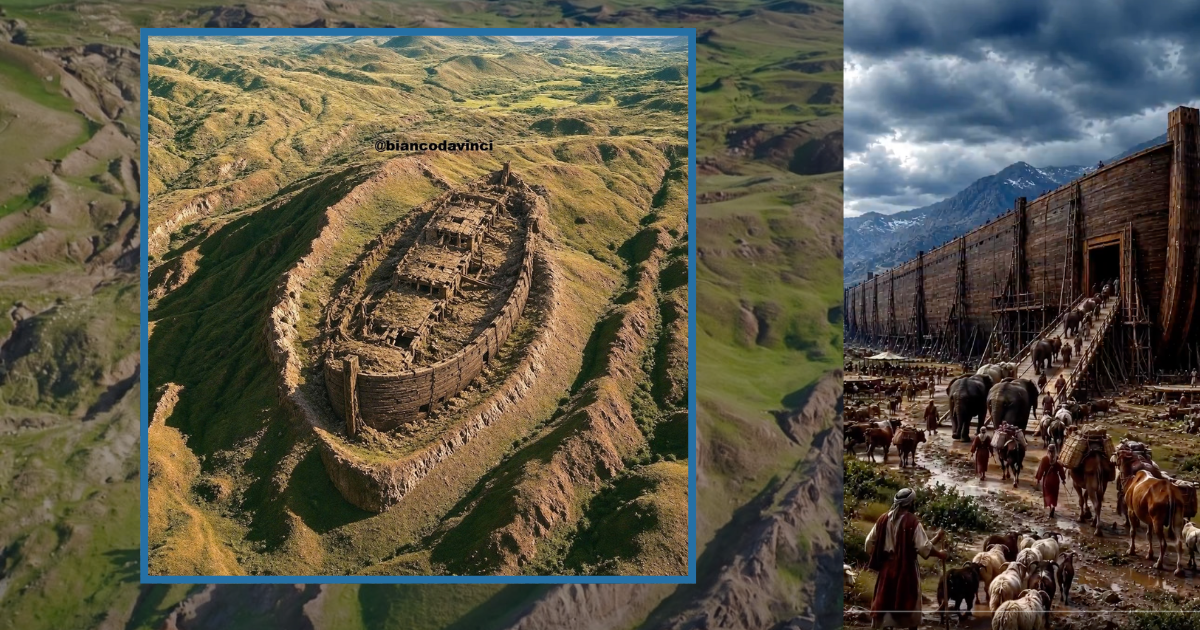
Researchers investigating the famous boat-shaped Durupınar formation in eastern Turkey say samples taken from the site have not yet been identified as ancient wood, adding an important new caution to claims that the location may contain remains of Noah’s Ark.
The site, near Mount Ararat in Ağrı Province, has attracted researchers, archaeologists and religious interest for decades because of its unusual ship-like shape.
Recent drilling and sampling work has renewed attention on the formation, but researchers say laboratory testing is still underway and no sample has yet provided confirmed evidence of ancient timber from a vessel.
No Confirmation of Ancient Wood Yet
The latest update is significant because some earlier reports and social-media posts suggested that investigators may have found material consistent with a wooden structure.
Researchers now stress that this has not been established.
The samples are being analyzed to determine their composition, age and whether they contain any material that could reasonably be associated with an ancient human-made structure.
Until those tests are complete, there is no scientific basis for claiming that ancient ship timber has been recovered.
The Durupınar Formation Remains a Mystery
The Durupınar site was first identified from aerial photographs in 1959 near the village of Telçeker in eastern Turkey.
Its elongated shape and dimensions have led some researchers to argue that it resembles the outline of a large vessel.
Over the decades, the site has been examined using ground-penetrating radar, geophysical surveys and other techniques. Some researchers have reported unusual subsurface features, but the broader scientific community has not reached a consensus that the formation is the remains of a ship.
A new international research project led by archaeologist Prof. Dr. Cenker Atila, with support from American researcher Andrew Jones, is continuing work at the site. Anadolu Agency reported this month that the area remains the subject of scientific study as well as international documentary projects.
Why the Site Continues to Attract Attention
The story of Noah’s Ark appears in religious traditions including Judaism, Christianity and Islam, making any potential archaeological connection to the story a subject of enormous public interest.
Supporters of the Durupınar theory often point to the formation’s shape, location and earlier geophysical anomalies as reasons to continue investigating.
Skeptics, however, argue that the formation can be explained by natural geological processes and note that no universally accepted archaeological evidence of a ship has been recovered.
That is why the new laboratory testing matters.
If researchers were to identify genuinely ancient processed wood, especially material showing evidence of human construction, it would significantly change the discussion around the site. For now, however, that evidence has not been produced.
Quran and Bible Point to Different Locations
The religious traditions do not identify exactly the same location for the Ark’s final resting place. In the Quran, Surah Hud 11:44 states that the vessel came to rest on Al-Judi, or Mount Judi. The Book of Genesis, meanwhile, says the Ark rested on the “mountains of Ararat.”
That distinction is important because the Durupınar formation being investigated today lies near Mount Ararat in eastern Turkey, while Mount Judi is traditionally identified farther south in southeastern Turkey.
Najbolje mjesto za ovaj dio je poslije “Why the Site Continues to Attract Attention”, prije završnog dijela “Research Continues.”
Research Continues
The latest findings do not prove that the Durupınar formation is Noah’s Ark — but they also do not end the investigation.
Researchers are continuing to analyze samples and study the geological and archaeological characteristics of the site.
For now, the most accurate conclusion is simple: the boat-shaped formation remains an intriguing archaeological and geological mystery, but ancient wood from Noah’s Ark has not yet been confirmed.
Sources: Newsweek, Anadolu Agency, Durupınar archaeological research reports
By NJ RADAR Team