


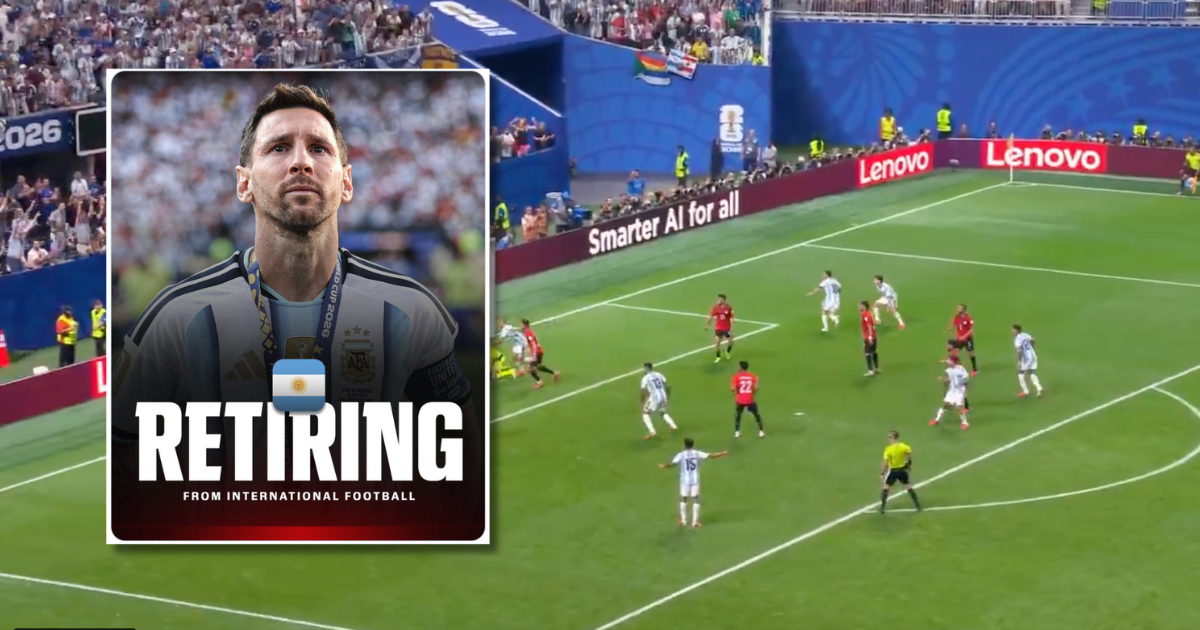
Lionel Messi has announced his retirement from international soccer, bringing an end to one of the most celebrated national team careers in the history of the sport.
The 39-year-old confirmed on Monday, August 31, that he will no longer represent Argentina, ending a journey with the national team that began more than two decades ago.
Messi leaves international soccer as Argentina’s all-time leader in both appearances and goals, finishing his career with 207 matches and 125 goals for his country.
His retirement follows another remarkable World Cup run this summer, when Argentina reached the 2026 final before losing 1-0 to Spain. Although Messi was unable to end his international career with a second consecutive World Cup title, the tournament added another chapter to a career already filled with historic achievements.
Messi’s relationship with the Argentina national team was not always an easy one.
For years, he faced enormous expectations and frequent comparisons with Diego Maradona. Argentina lost the 2014 World Cup final and suffered several painful defeats in Copa América finals, leading Messi to briefly announce his international retirement after the 2016 Copa América Centenario final.
He later reversed that decision and returned to the national team.
The second half of his international career transformed his legacy.
Messi finally won his first major senior international trophy when Argentina captured the Copa América in 2021. A year later, he led the country to victory at the 2022 FIFA World Cup in Qatar, fulfilling a lifelong ambition and securing the trophy that had eluded him throughout much of his career.
Argentina then won another Copa América title in 2024.
Messi also helped Argentina win the Finalissima in 2022 and had previously won Olympic gold with the country in 2008 and the FIFA World Youth Championship in 2005.
At the 2022 World Cup, Messi was named the tournament’s best player and became the first footballer to win the World Cup Golden Ball twice.
Even at 39, he continued breaking records.
During the 2026 World Cup, Messi became the tournament’s all-time leading scorer when he scored twice against Austria, although that record was later surpassed by France star Kylian Mbappé.
Messi also remained a crucial part of Argentina’s run to the 2026 World Cup final, providing two late assists in the semifinal victory over England.
His retirement applies only to international soccer.
Messi continues to play professionally for Inter Miami in Major League Soccer and recently extended his contract with the club through 2028. Just one day before announcing his international retirement, he scored four goals and added an assist in Inter Miami’s 7-1 victory over CF Montreal.
Messi’s departure closes an extraordinary chapter for Argentina.
After years of frustration and criticism, he ultimately helped deliver the trophies that had once seemed beyond reach and leaves the national team as its most prolific scorer and most-capped player.
From his debut in 2005 to lifting the World Cup trophy in 2022 and leading Argentina to another final in 2026, Messi’s international career lasted more than 20 years.
For Argentina, the challenge now begins of entering a new era without the player who defined its national team for a generation.
Source: ABC News on X
By NJ RADAR Team