


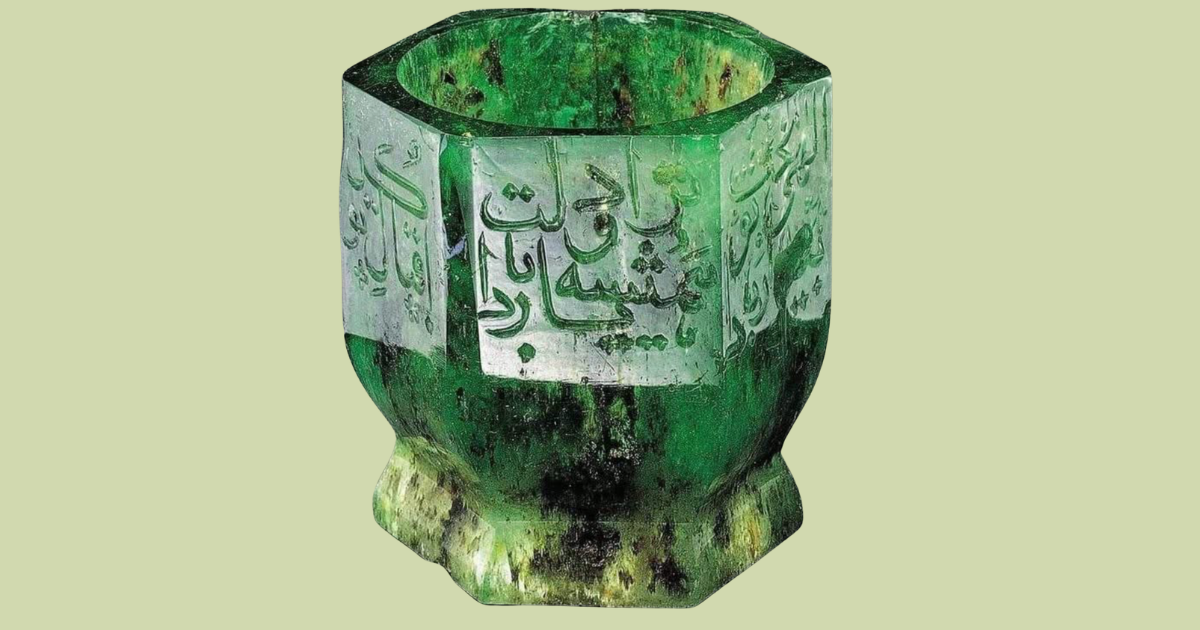
A remarkable emerald cup from the Mughal period offers a glimpse into the extraordinary luxury and technical skill of royal workshops in India more than four centuries ago.
The small vessel was carved from emerald during the 16th or 17th century, when the Mughal Empire was one of the wealthiest and most powerful courts in the world. Comparable surviving examples are associated with the reign of Emperor Jahangir, who ruled from 1605 to 1627 and was known for collecting drinking vessels made from precious and semi-precious stones.
One particularly famous Mughal emerald cup weighs about 252 carats and carries Persian verses carved into its surface. Another spectacular example, now in the Museum of Islamic Art in Qatar, has a bowl weighing more than 408 carats and was fashioned from exceptionally fine Colombian emerald.
The connection between South America and Mughal India is itself remarkable. Colombian emeralds reached India through Portuguese trading networks after the European arrival in the Americas. The Mughal court became an important destination for these unusually large and intensely colored stones.
Working with emerald required enormous precision. Unlike softer decorative materials, emerald is brittle and can contain natural fractures. A single mistake while hollowing or carving the stone could destroy an exceptionally valuable gem.
Craftsmen nevertheless transformed these stones into delicate drinking vessels, carefully following the natural geometry of the emerald crystal. Some surviving cups retain a hexagonal form that reflects the six-sided structure in which emerald naturally crystallizes.
The objects were more than displays of wealth. Their inscriptions, intricate carving and precious materials reflected the artistic culture of the Mughal court, where Persian poetry, jewelry, architecture and highly refined decorative arts flourished side by side.
More than 400 years later, these tiny vessels remain striking examples of how global trade, royal ambition and extraordinary craftsmanship came together in a single object.
By NJ RADAR Team