


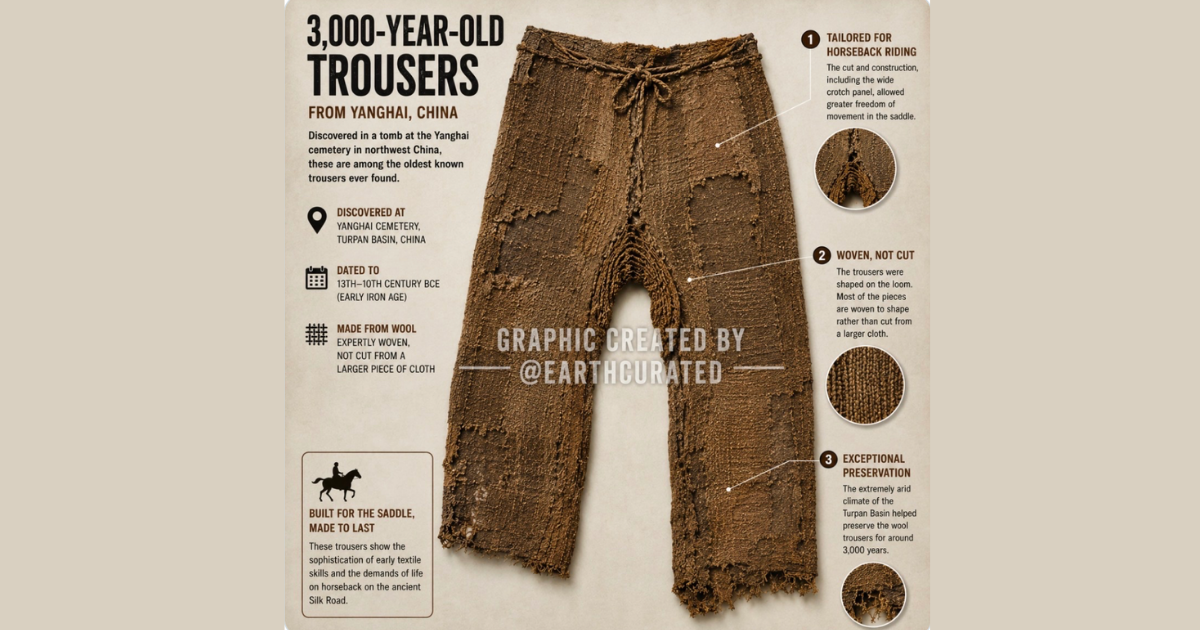
Around 3,000 years ago, people living at Yanghai in what is now northwestern China were already producing remarkably sophisticated wool trousers designed for life on horseback.
The ancient trousers, discovered at the Yanghai cemetery near Turfan, are considered among the oldest surviving examples of pants ever found. They date to roughly the late second to early first millennium BCE and were made for riders who needed both protection and freedom of movement.
What makes the garment especially impressive is the way it was constructed.
Instead of weaving a large sheet of fabric and cutting it into separate pieces, ancient textile makers shaped much of the trousers directly on the loom. The legs, crotch and other sections were created using carefully controlled weaving techniques, reducing the need for extensive cutting and sewing.
Researchers studying the trousers found evidence of several different textile methods within the same garment, showing that the makers possessed a surprisingly advanced understanding of structure, flexibility and durability.
The design was particularly well suited for horseback riding. The trousers allowed a rider to spread and bend the legs comfortably while sitting in a saddle, something that traditional robes or wrapped garments could not provide as effectively.
Their development is closely connected to the growing importance of horseback riding across Central Asia. As horses became increasingly important for travel, herding and warfare, clothing also had to change.
The Yanghai trousers show that this adaptation was not simply practical. It was also technically sophisticated.
More than three millennia later, the basic idea behind the garment remains familiar: two separate legs joined by a flexible central section, designed to follow the movement of the human body.
It is a striking reminder that some solutions we consider ordinary today were already the result of highly skilled engineering thousands of years ago.
Source: Earth Curated on X; archaeological research on the Yanghai trousers
By NJ RADAR Team