


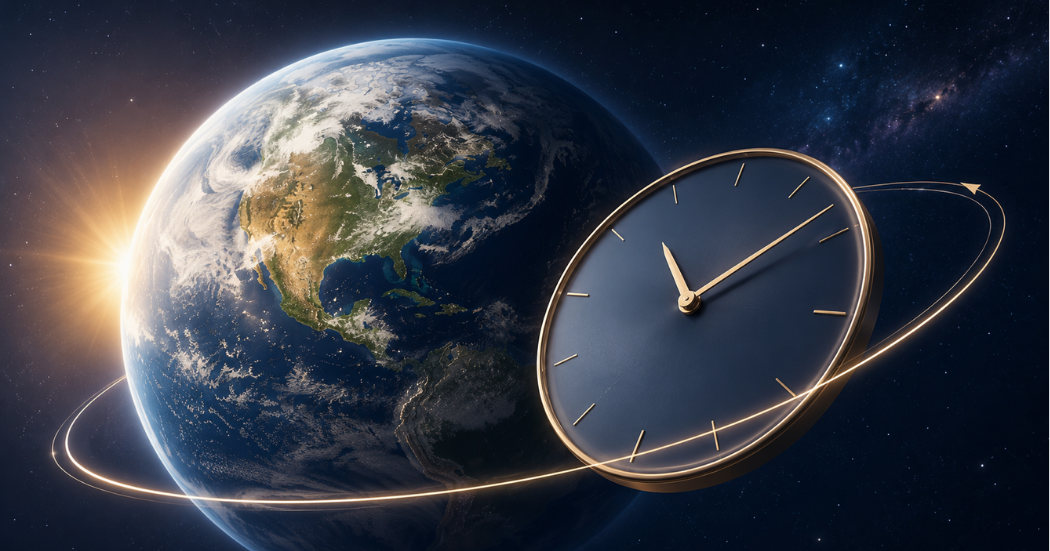
Earth’s days are slowly becoming longer as the planet’s rotation gradually slows, raising an intriguing possibility: far in the future, a day on Earth could eventually last 25 hours instead of 24.
The change is real, but it is happening on an extraordinarily slow timescale.
The main reason is the gravitational interaction between Earth and the Moon. The Moon creates tides in Earth’s oceans, and the resulting tidal friction gradually slows the planet’s rotation. NASA estimates that this long-term effect increases the length of an Earth day by about 2.3 to 2.4 milliseconds per century.
At that rate, adding an entire extra hour to the day would take well over 100 million years if the present long-term rate remained similar. The actual future rate cannot be predicted simply by extending today’s numbers because the Earth-Moon system and other geophysical processes continue to change.
The slowing of Earth’s rotation also affects the Moon. As angular momentum is transferred from Earth to the Moon, the Moon gradually moves farther away from our planet.
Climate Change Is Also Affecting Earth’s Rotation
The Moon is not the only influence.
NASA-funded research has found that melting glaciers and ice sheets are redistributing enormous amounts of water across the planet. As ice melts near the poles and water moves toward the oceans, Earth’s mass distribution changes slightly, which can further slow its rotation.
Researchers found that climate-related changes have added about 1.33 milliseconds per century to the length of the day since 2000. Under a high-emissions scenario, that effect could reach approximately 2.62 milliseconds per century by 2100, potentially becoming larger than the contribution from lunar tidal friction.
A useful comparison is a spinning ice skater: when the skater extends their arms outward, they rotate more slowly. Moving water away from Earth’s poles toward lower latitudes has a similar, although extremely small, effect on the planet.
Earth Does Not Always Slow Down
The story is slightly more complicated because Earth’s rotation does not change at a perfectly steady rate.
Atmospheric circulation, ocean currents, movement inside Earth’s core, groundwater, ice and other processes can make individual days slightly shorter or longer. NASA says these variations can amount to milliseconds.
Earth even experienced several unusually short days during recent years as the planet temporarily rotated slightly faster. Data from 2026, however, indicated that days were beginning to lengthen again compared with the exceptionally fast rotation recorded earlier in the decade.
So while the familiar 24-hour day will remain with humanity for an unimaginably long time, Earth’s rotation is not perfectly fixed.
A 25-hour day may technically be possible in the distant future — but no one will need to reset their alarm clock anytime soon.
Sources: NASA; NASA Goddard Space Flight Center; NASA Jet Propulsion Laboratory; Timeanddate.com
By NJ RADAR Team