


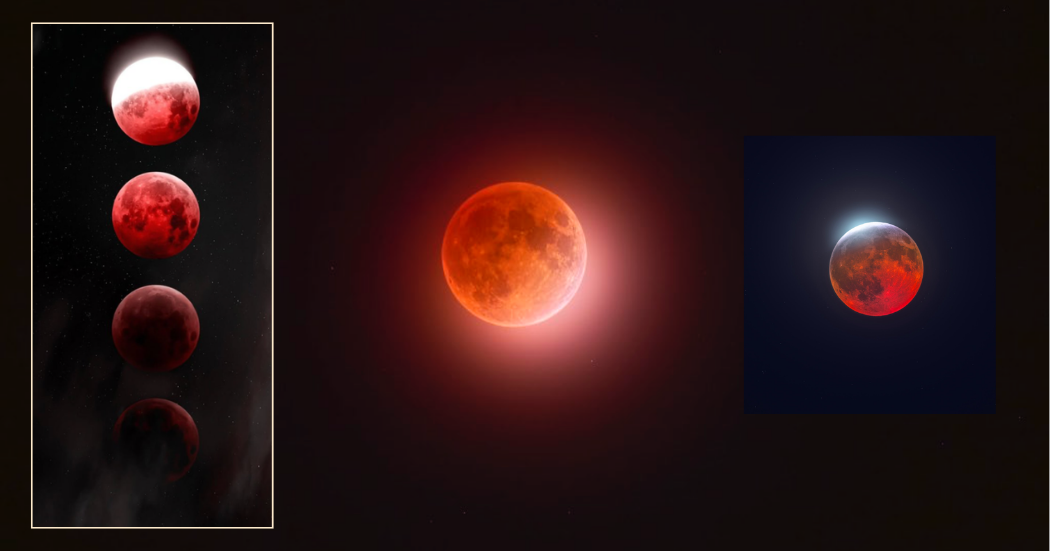
Skywatchers across large parts of the world were treated to a dramatic celestial display overnight as a deep partial lunar eclipse transformed most of the Moon into shades of copper, orange and dark red.
The eclipse unfolded during the night of August 27 into the early hours of August 28, with observers across North and South America, Europe and Africa able to see at least part of the event. NASA listed the eclipse as visible across the Americas, Europe, Africa and western Asia.
Although images from around the world gave the Moon the familiar appearance of a “Blood Moon,” technically this was not a total lunar eclipse. At the maximum point, about 96% of the lunar disk entered Earth’s dark central shadow, or umbra, leaving only a thin portion illuminated directly by the Sun.
The eclipse peaked at approximately 12:12 a.m. Eastern Time on Friday, making it particularly well positioned for viewers across much of the United States. In Central Time, the maximum occurred around 11:12 p.m. Thursday, while viewers farther west saw it earlier in the evening.
For observers in Europe, the spectacle came shortly before sunrise. In cities including London, Paris, Madrid and Brussels, the Moon appeared low on the western horizon as Earth’s shadow covered nearly its entire surface. In parts of Europe farther east, the Moon set before the eclipse reached its maximum.
Why Did the Moon Turn Red?
A lunar eclipse occurs when Earth moves between the Sun and the full Moon, causing the Moon to pass through Earth’s shadow.
The reddish color comes from sunlight traveling through Earth’s atmosphere before reaching the lunar surface. Shorter blue wavelengths are scattered more strongly, while red and orange light passes through the atmosphere and is bent toward the Moon.
In effect, the red light reaching the eclipsed Moon is produced by the combined glow of sunrises and sunsets around Earth.
Because approximately 96% of the Moon entered the umbra overnight, much of its surface could take on a deep copper or reddish appearance while a narrow bright section remained visible.
Seen From Different Parts of the World
The same astronomical event appeared differently depending on location, weather and the Moon’s height above the horizon.
Across North America, observers had some of the best opportunities to watch the eclipse develop through its deepest phase. South America also had extensive visibility, while parts of Europe and Africa watched the eclipsed Moon descend toward the horizon as dawn approached.
According to estimates cited by Space.com, around 1.3 billion people were geographically positioned to see the entire partial phase, weather permitting.
For photographers, the low Moon in some parts of the world created particularly striking scenes as the reddish lunar disk appeared above cities, mountains and familiar landmarks.
Nearly Total, But Not Quite
The tiny illuminated portion of the Moon is what separated last night’s eclipse from a true Blood Moon.
During a total lunar eclipse, the entire Moon enters Earth’s umbra. This time, about 96% entered the darkest part of the shadow, producing what astronomers describe as a deep partial lunar eclipse.
That small difference was difficult to miss visually: at maximum eclipse, most of the Moon appeared dark red while a thin bright edge remained.
The event was nevertheless unusually deep. Astronomy publications describe it as the most impressive lunar eclipse visible from many locations for some time, with the next total lunar eclipse not occurring until the transition from December 31, 2028, to January 1, 2029.
For millions of people looking up overnight, however, the technical distinction mattered little. Across several continents, the same Moon briefly changed from its familiar bright white appearance into a dark, copper-colored world hanging in Earth’s shadow.
Sources: NEWSMAX / X; Asbury Park Press / X; @Banter_God1 / X; Pop Crave / X; NASA; Space.com
By NJ RADAR Team