


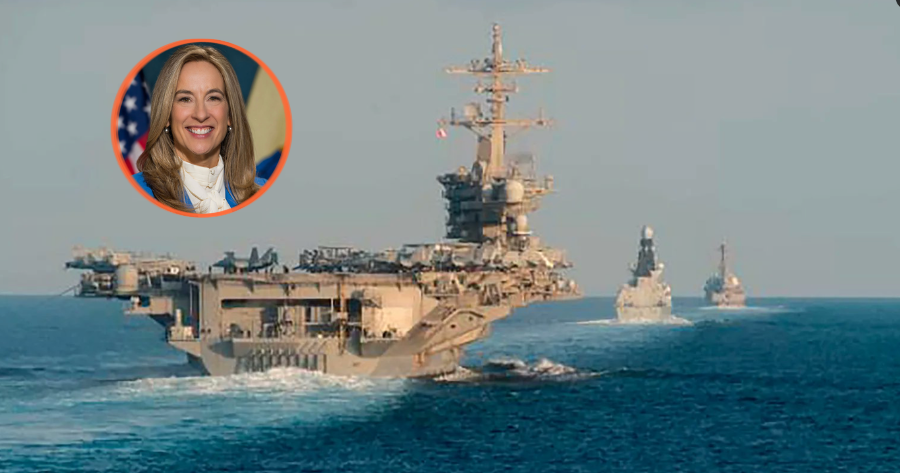
The USS Abraham Lincoln has spent more than 240 straight days at sea, with sailors reportedly going through all of 2026 without a single port visit. For thousands of crew members aboard the aircraft carrier, that has meant months of continuous deployment, limited rest and growing concerns about living conditions.
New Jersey Gov. Mikie Sherrill is now sounding the alarm.
In a series of posts Tuesday, Sherrill pointed to reports of food shortages, broken toilets and showers, unsanitary conditions, severe exhaustion and mental-health problems, including reports of sailors attempting to jump overboard.
Sherrill, who served nearly 10 years in the Navy and later almost seven years on the House Armed Services Committee, argues that the situation aboard the Lincoln is not an isolated problem.
She says it is the result of a much broader strain on the U.S. Navy — damaged logistics hubs in the Middle East, increasingly difficult resupply operations, exceptionally long carrier deployments and decisions that are moving American naval forces from one crisis to another.
In her original post and follow-up comments on the same X thread, Gov. Mikie Sherrill said sailors aboard the USS Abraham Lincoln have spent more than 240 consecutive days at sea and cited reports of food shortages, broken toilets and showers, unsanitary conditions, severe exhaustion and mental-health concerns, including sailors attempting to go overboard. She also linked the carrier’s difficulties to the war with Iran, damage to key naval logistics hubs, longer resupply routes and broader decisions involving U.S. carrier deployments.
More Than 200 Days Without a Port Call
The USS Abraham Lincoln left San Diego in November 2025 and made a port visit in Guam the following month before being redirected toward the Middle East.
Since then, the aircraft carrier has remained at sea for more than 200 consecutive days without entering port.
Reuters reported in August that the Lincoln’s overall deployment had exceeded 260 days, with roughly 5,000 sailors and Marines aboard.
That prolonged deployment has placed extraordinary demands on the crew.
Reports from sailors’ families and military advocates have described problems involving food quality and availability, plumbing failures, drinking-water concerns, extreme fatigue and limited opportunities for rest.
Mental-health concerns have received particular attention after reports emerged of sailors attempting to go overboard.
The Navy has pushed back against some of the most dramatic descriptions of conditions aboard the ship and has said the Lincoln continues to receive supplies while at sea.
Navy Disputes Claims of Widespread Shortages
U.S. Navy vessels do not necessarily need to enter port to receive supplies.
Aircraft carriers can be replenished at sea, receiving food, fuel and other necessities from support ships while remaining operational.
Military officials have said the Lincoln has continued receiving such replenishments and have disputed claims that the crew is facing widespread deprivation of essential supplies.
Defense Secretary Pete Hegseth and other officials have also argued that some reports about conditions aboard the carrier have been exaggerated.
But families of sailors have publicly challenged those assurances.
Some have described significant weight loss, poor nutrition, exhaustion and difficulty obtaining adequate mental-health support during the extended deployment.
The disagreement has created two sharply different pictures of life aboard the Lincoln: one presented by military leadership, which says the ship remains operational and supplied, and another coming from some families and advocates who say sailors are being pushed too far.
Sherrill Says the Problem Began With a Breakdown in Naval Logistics
In a follow-up post, Sherrill argued that many of the Lincoln’s difficulties are tied to the wider conflict with Iran and damage to key American military and logistics facilities in the Persian Gulf.
She pointed specifically to Bahrain, home of the U.S. Navy’s 5th Fleet, and Jebel Ali Port in the United Arab Emirates.
Sherrill said Iranian missile and drone attacks on critical naval bases and logistics hubs changed the security situation and made traditional resupply operations more difficult.
Bahrain has particular significance for Sherrill personally. She noted that she served there during her own Navy career.
She also emphasized the scale and importance of Jebel Ali, one of the world’s largest ports and a major logistics hub routinely used by U.S. Navy vessels operating in the region.
According to Sherrill, increased security concerns around those facilities have forced major resupply operations to rely more heavily on Diego Garcia, a remote U.S.-British military base in the Indian Ocean.
“Take a look at it on a map,” she wrote. “It’s not close.”
That additional distance, she argues, has made an already difficult carrier deployment even more complicated.
From Bahrain to Diego Garcia
The geography helps explain her argument.
Bahrain and Jebel Ali sit close to the Persian Gulf, where U.S. naval forces have traditionally operated and resupplied.
Diego Garcia, by contrast, is located thousands of miles away in the central Indian Ocean.
Reports examining the Lincoln’s supply problems have similarly linked damage and security concerns surrounding the Navy’s logistics infrastructure in Bahrain with longer and more complicated resupply routes.
That does not mean the Lincoln cannot be supplied.
It does mean that maintaining a massive aircraft carrier and thousands of personnel at sea becomes considerably more difficult when nearby ports and logistics centers cannot be used normally.
And Sherrill argues that those complications were made worse by decisions made in Washington.
Another Carrier Already Set a Record
Sherrill also pointed to the USS Gerald R. Ford as evidence that the Navy’s current deployment tempo is putting unusual strain on ships and crews.
Earlier this year, the Ford surpassed the post-Vietnam-era record for the longest U.S. aircraft carrier deployment.
The carrier ultimately completed a deployment of approximately 326 days.
Sherrill says the Lincoln’s situation should therefore not be viewed as a single unusual mission, but as part of a broader pattern in which American aircraft carriers and their crews are spending exceptionally long periods away from home.
Long carrier deployments affect more than operational readiness.
They also mean months of separation for thousands of military families, while sailors face limited privacy, difficult working conditions, long shifts and little opportunity to leave the ship.
USS George Washington Is Being Pulled From the Pacific
Now another major strategic decision is drawing attention.
The USS George Washington is being moved from the Pacific toward the Middle East, where it is expected to eventually relieve the Abraham Lincoln.
That could finally provide relief for Lincoln’s exhausted crew.
But Sherrill warns that moving George Washington creates another problem.
The move temporarily leaves the western Pacific without a U.S. aircraft carrier battle group at a time of heightened tensions with China.
For decades, aircraft carriers have been one of the most visible symbols of U.S. military power in the Pacific, particularly as Washington monitors China’s growing naval capabilities and tensions surrounding Taiwan and the South China Sea.
Sherrill argues that moving the George Washington illustrates how stretched the Navy has become.
Relieving one overworked carrier may create a strategic gap somewhere else.
Sherrill Directly Blames Trump and Hegseth
The governor did not limit her criticism to military logistics.
She placed political responsibility directly on President Donald Trump and Defense Secretary Pete Hegseth, describing the war with Iran as poorly conceived and accusing Hegseth of failing to understand the complexity of naval deployments.
Those are Sherrill’s political assessments, rather than independently established facts.
She also accused Hegseth of politicizing the military and criticized personnel decisions involving senior Navy leaders.
Among those she mentioned were former Chief of Naval Operations Adm. Lisa Franchetti and Rear Adm. Michael Bauerschmidt, who previously commanded the Abraham Lincoln.
Sherrill said the removal or sidelining of experienced military leaders has weakened the Navy at a moment when increasingly complicated global operations require experienced leadership.
Her criticism also extends to the administration’s handling of Black and female service members, an issue that has become part of a wider political fight over diversity programs and personnel policy inside the military.
Again, those claims represent Sherrill’s interpretation of Pentagon leadership and policy.
Trump Says the Deployment Was “Not Nearly Long Enough”
The controversy intensified when President Trump was asked about concerns surrounding the Lincoln’s long deployment.
Reuters reported that Trump responded that the deployment was “not nearly long enough.”
The remark drew criticism from some military families and lawmakers who argue that the physical and psychological toll of exceptionally long deployments should be taken more seriously.
Military leaders, however, must balance crew welfare against operational demands, particularly during periods of conflict or heightened international tension.
That is precisely where the debate over the Lincoln has become more complicated.
The question is no longer simply whether an aircraft carrier can remain at sea for this long.
The question is whether it should.
Other Navy Problems Add to Concerns
The Abraham Lincoln is not the only U.S. Navy ship to face questions about living conditions and operational strain.
The destroyer USS Benfold recently experienced a multi-day power failure in the Pacific that reportedly left hundreds of sailors without normal electricity, potable water, working toilets, hot meals or air conditioning until assistance arrived.
Taken together with the Lincoln’s extended deployment and the Ford’s record-setting mission, incidents like these are fueling a wider debate over whether the Navy’s operational demands are exceeding the limits of its ships, sailors and logistics system.
Why Sherrill Is Speaking Out
Sherrill’s intervention carries additional weight because of her own military background.
Before entering politics, she spent nearly a decade in the U.S. Navy, flying helicopters and serving in several roles, including overseas.
She later served in Congress and spent nearly seven years on the House Armed Services Committee, where she worked on military policy, readiness and defense issues.
Her latest comments therefore combine two roles: governor of New Jersey and former naval officer.
She says New Jersey residents should care about what is happening aboard the Lincoln because military readiness ultimately depends on the sailors asked to carry out the mission.
And behind every sailor aboard a deployed ship is also a family waiting at home.
The Larger Question
The Pentagon maintains that the Abraham Lincoln remains capable of performing its mission and continues to receive necessary supplies.
Sherrill and other critics argue that simply keeping a carrier operational is not the same thing as ensuring acceptable conditions for the people aboard it.
After more than eight months of deployment, more than 200 consecutive days without entering port and mounting reports of physical and psychological strain, the Lincoln has become a symbol of a much larger question facing the U.S. Navy:
How long can sailors be asked to remain at sea before military necessity begins to undermine the very readiness it is supposed to protect?
The expected arrival of the USS George Washington could finally bring relief for the Abraham Lincoln.
But Sherrill’s warning goes beyond one ship.
Her argument is that the United States is increasingly moving aircraft carriers around the globe to solve one immediate crisis after another — while the sailors aboard them are paying the human cost.
Naravno. Stavi sva tri X izvora zajedno ovako:
Sources: Gov. Mikie Sherrill (@GovSherrillNJ) on X; Press TV Türk (@presstvturk) on X; Al Hadath News (@Alhadath_news1) on X; Reuters; Associated Press; U.S. Navy; USNI News.
By NJ RADAR Team
[…] USS Abraham Lincoln left San Diego in November 2025 and was later sent to the Middle East. By August, it had spent […]