


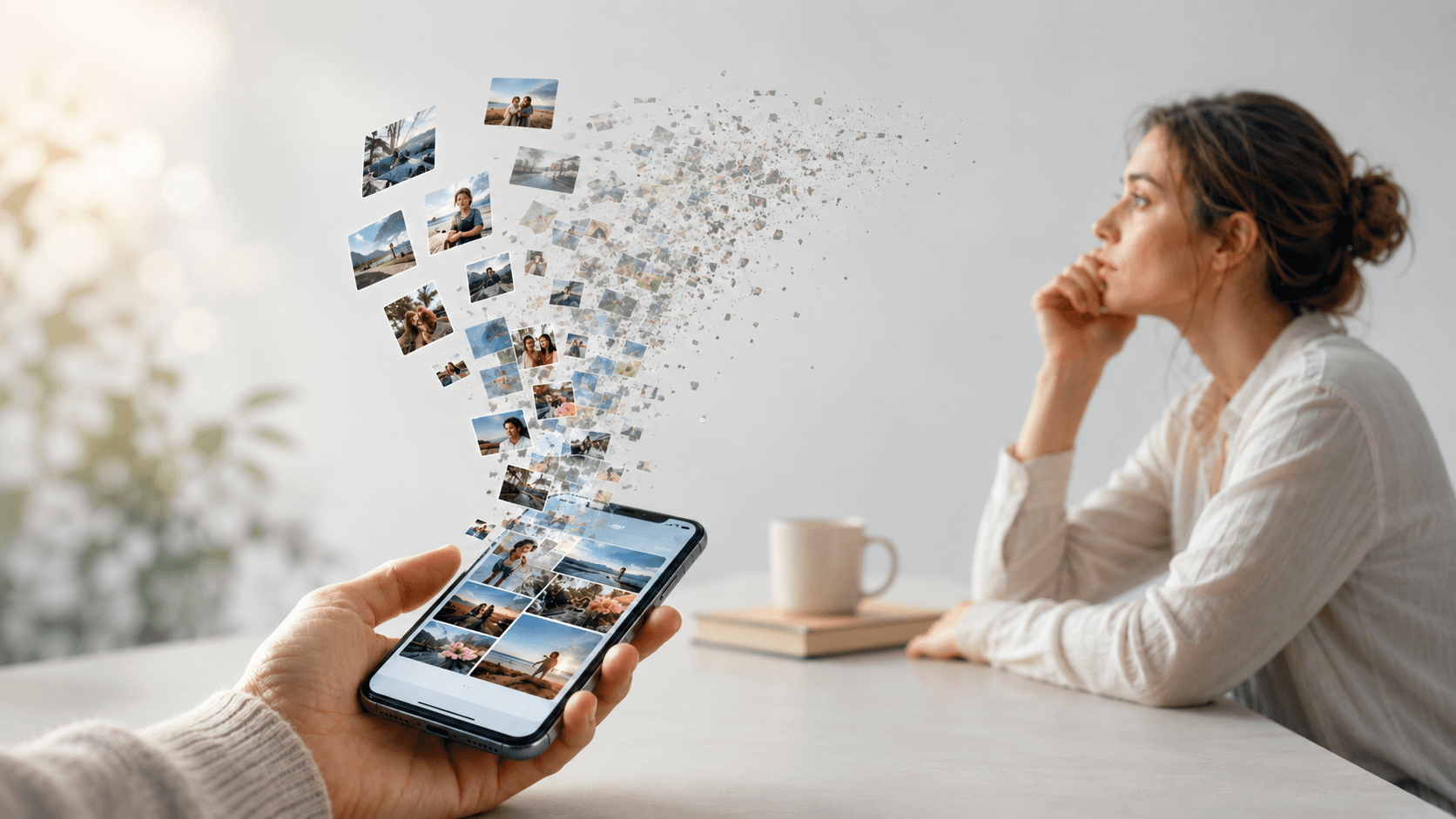
📱 We take a screenshot so we can remember something — but what if doing that actually makes us more likely to forget it?
How many times have you seen something interesting on your phone and immediately thought: “I’ll save this so I don’t forget it.” One click, the screenshot is taken, and the information is safely stored. But what if our brain then decides it no longer needs to work as hard to remember it?
That is exactly the question explored in new research from psychologists at Binghamton University in New York, published on August 17, 2026. The researchers examined what they call the “digital capture effect” — what happens to our memory when we simply transfer information to our phones.
The results are interesting: participants later remembered images they had screenshotted less well than images they had only viewed. The research also found that taking a screenshot did not provide any clear cognitive benefit — for example, it did not help participants perform better on new math problems later.
Why does this happen?
The researchers also tested an explanation known as “cognitive offloading” — the idea that the brain transfers part of its mental workload to an external tool, essentially deciding: I don’t need to remember this because my phone will save it for me. However, the results did not provide enough evidence to show that this is the main reason memory becomes weaker.
Divided attention may also play some role, because the act of taking a screenshot requires additional mental activity. Still, researchers do not believe that this fully explains the effect either.
One possibility they are now considering is something called “attentional disengagement” — the idea that the act of capturing something may unconsciously pull us mentally away from what we are looking at. Instead of focusing completely on the content, part of our attention shifts to the action of recording and saving it. As a result, the information may not be processed deeply enough to remain in memory later.
In other words, scientists still do not have a final answer for why taking screenshots can weaken memory, but the results suggest that the simple act of digitally “saving” information may change the way our brain processes it.
This is not the first time scientists have observed a similar effect. Earlier research from Binghamton University found that people who photographed certain objects or events could later remember what they photographed less well.
But there is an important nuance: this does not mean we should stop taking photos or screenshots.
If we later return to a photograph or saved piece of information and actually look at it again, it can help us remember. The problem may be that today we save enormous amounts of information — and rarely go back to look at it.
So perhaps the real question is this:
Do we now have more information saved than ever before — while remembering less of it than ever before?
Maybe our phones have not stolen our memory.
Maybe we have simply started trusting them to remember for us.
And you — how many screenshots do you have on your phone that you have never looked at again? 📱
Sources:
Binghamton University – “Taking screenshots makes you more likely to forget information”
Binghamton University – “Taking photos can impair your memory of events”
Binghamton University Research Days – “Digital Amnesia: The Aftermath of a Screenshot”
By NJ RADAR Team