


Today, it sounds almost unbelievable, but less than seventy years ago, people were still being displayed before the public in the heart of Europe as part of a colonial spectacle.
At the 1958 World’s Fair in Brussels, known as Expo 58, Belgium created a so-called “Congolese Village” in which people from what was then the Belgian Congo were presented to visitors as part of the exhibition.
It became one of the last major examples of what is now commonly referred to as a “human zoo.” Belgium’s Royal Museum for Central Africa describes Expo 58 as the final large-scale manifestation of this type at the end of the era of colonial exhibitions.
People as Part of the Exhibition
These displays did not begin in 1958. Their history stretches deep into the nineteenth century.
People from Africa, Asia, the Americas and Oceania were brought to Europe and the United States and presented to audiences in “exotic villages,” colonial pavilions and staged scenes of everyday life.
The public was not encouraged to see them as individuals with their own lives, families and identities, but rather as representatives of supposedly “primitive” peoples.
The AfricaMuseum states that nearly 35,000 people were exhibited in such displays around the world over the decades, while more than a billion visitors saw them.
Their purpose was not only entertainment. Colonial powers also used them as propaganda.
The message was simple: present colonized peoples as “backward” and European countries as a civilizing force that supposedly needed to educate and modernize them. Today, the AfricaMuseum openly acknowledges that these exhibitions helped promote ideas of Western superiority and were used to justify colonialism.
Belgium Had Done It Before, in 1897
Belgium had a long history of such exhibitions.
During the 1897 International Exhibition in Brussels, a colonial section was created in Tervuren where people from the Congo were put on display.
Not everyone survived their stay in Belgium. Eight people died during the 1897 exhibition.
That event was also connected to the creation of the institution that would later become today’s Royal Museum for Central Africa.
Sixty-one years later, Belgium created another “Congolese Village.”
Expo 58: Modern Europe and a Colonial Village
Expo 58 was supposed to represent the future.
Brussels showcased new architecture, technology, science and the optimism of the postwar world. The Atomium, built specifically for the exhibition, became a symbol of modern Belgium.
Yet at the same time, only a short distance from that image of the future, people from the Congo were again being presented as a colonial attraction.
More than 600 Congolese people came to Belgium, and around 120 people per day were presented to visitors in the so-called Tropical Gardens. At night, they were housed in a separate facility in Tervuren.
Belgium used the massive colonial pavilion to promote what it portrayed as its achievements in the Congo — just as demands for Congolese independence were becoming increasingly powerful.
Visitors Threw Food
What was intended to be a controlled colonial presentation quickly became a source of humiliation and protest.
Visitors treated the people in the “village” as attractions. The behavior of some members of the public was so degrading and racist that Congolese participants began to protest.
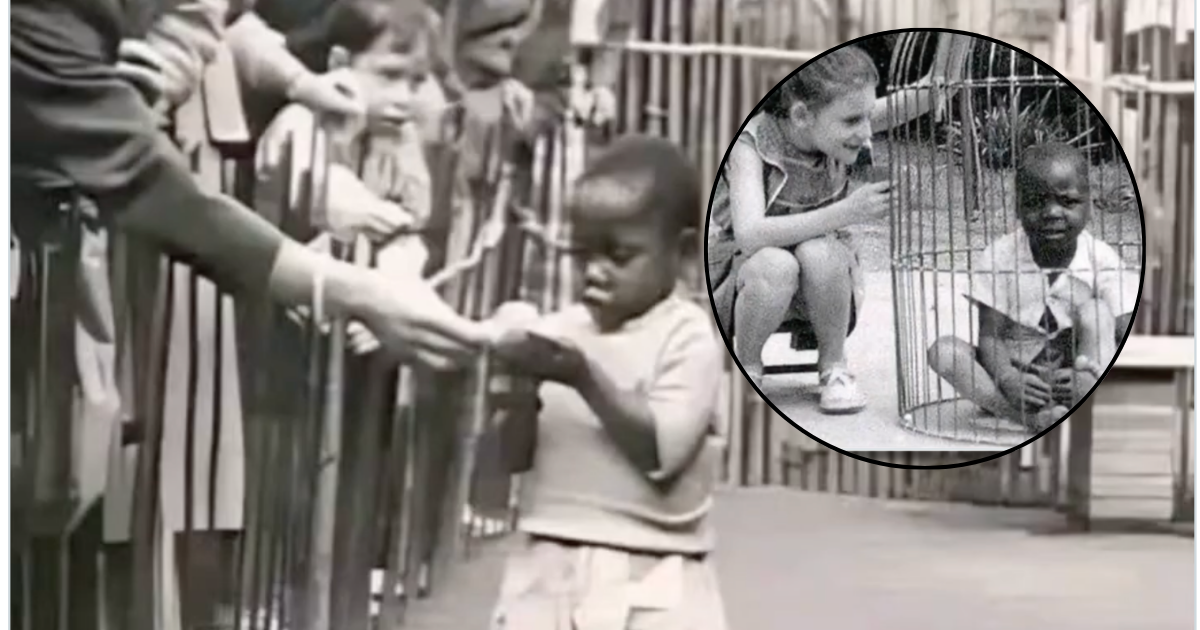
Photographs from the period became symbols of the era: white European visitors looking at Black men, women and children behind barriers as though they were observing animals in a zoo.
Congolese students and intellectuals living in Belgium also protested against this treatment.
Eventually, many participants refused to continue. The “village” was closed before the exhibition itself ended.
A Child Who Never Returned Home
Expo 58 also had one particularly tragic story.
Juste Bonaventure Langa, a baby only eight months old, died during the exhibition. The exact cause of death is not known.
He was buried in a cemetery in Tervuren, where his grave still exists today.
His story gives a human face to something that is often reduced to a historical term.
Because behind the words “human zoo” were not anonymous exhibits.
They were people.
Only Two Years Later, Congo Became Independent
One of the most striking ironies of Expo 58 is the moment in history when it took place.
Belgium was still trying to present its colonial system as something positive and permanent.
Only two years later, on June 30, 1960, Congo gained independence from Belgium.
The world of colonial exhibitions was disappearing along with Europe’s colonial empires.
Today, the AfricaMuseum places Expo 58 at the very end of that period — one of the last major colonial displays of its kind, at a time when old ideas about colonized peoples were already beginning to collapse.
The Photographs Also Need Context
Many photographs that circulate online today in stories about Belgium’s “human zoo” are incorrectly labeled as images from Expo 58.
Not all of them are.
The Royal Museum for Central Africa holds a large collection of photographs from the Belgian Congo during the 1950s. Many were produced through the colonial information service Inforcongo, which was created in part to promote a positive image of Belgian colonial rule.
The museum now warns that these photographs should also be viewed critically, including questions of staging, propaganda and what was presented at the time as “authentic” life in the Congo.
So a photograph can be an authentic image from the colonial period without necessarily having been taken at Expo 58.
That does not weaken the history of human exhibitions. On the contrary, it helps tell that history more accurately.
Context note: The last major human zoo exhibition in Belgium took place in 1958. However, the images shown in the video below are not all from that exhibition. Some of the photographs were taken in the Belgian Congo during the 1950s and are included to provide broader historical context on human exhibitions and colonial-era displays.
These images are shared for historical and educational purposes and should not be interpreted as suggesting that every photograph shown comes from the 1958 Belgian exhibition.
This Is Not Ancient History
Perhaps the year 1958 is what makes this story so striking.
This was not the Middle Ages.
People who were children at the time may still be alive today.
Television already existed. Airplanes crossed the Atlantic. Nuclear energy was being presented as the technology of the future. Europe was rebuilding after World War II.
And people could still be placed behind barriers for others to observe.
That is why the history of “human zoos” is not only a story about colonialism.
It is also a reminder of how quickly something one generation accepts as normal can, only a few decades later, be recognized as profoundly degrading.
Sources: Royal Museum for Central Africa / AfricaMuseum; Human Zoo: The Age of Colonial Exhibitions; AfricaMuseum historical archives and Inforcongo photography collection.
By NJ RADAR Team