


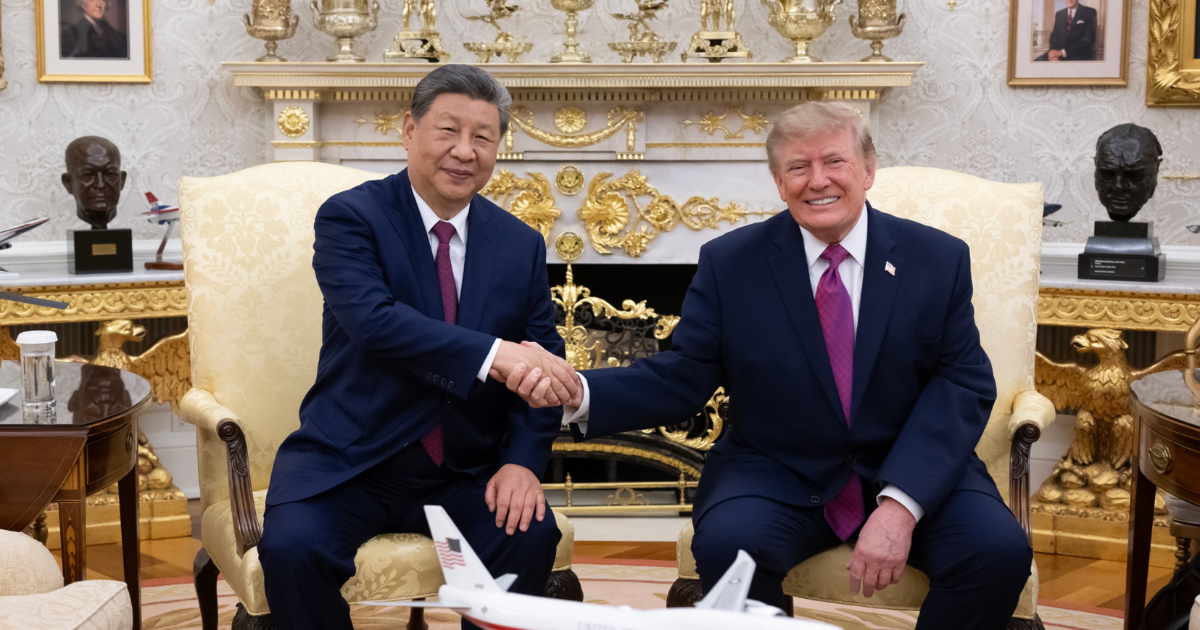
President Donald Trump asked Chinese President Xi Jinping during their recent meetings whether China would be interested in buying American military equipment, according to U.S. Ambassador to China David Perdue.
The unusual exchange came during Xi’s three-day state visit to the United States, from September 23 to 25, which included bilateral talks, ceremonial events and a state dinner at the White House. The visit marked Xi’s first state visit to Washington in 11 years.
According to Bloomberg, Perdue said Trump at one point asked Xi whether he would like to purchase American armaments. No agreement on such a purchase was announced, and the exchange appears to have been part of the broader discussions between the two leaders rather than a formal arms proposal.
A High-Profile State Visit
Trump personally greeted Xi at Joint Base Andrews on September 23 before the formal White House program began the following day.
The visit included an official arrival ceremony, bilateral talks, a state dinner, tea at the White House and a visit to the National Archives. The White House described the meetings as part of an effort to build what both governments called a “constructive relationship of strategic stability.”
The two countries later said that relationship would be based on “respect, fairness, and reciprocity.”
Xi Calls for More Cooperation — Even Amid Competition
China’s official readout presented the meeting as part of a broader effort to stabilize relations between the world’s two largest economies.
Xi said cooperation should remain the mainstay of the relationship, while competition should stay within limits and differences should remain manageable. He also called for expanding areas of economic cooperation while reducing areas of dispute.
Xi separately called for broader engagement between the two countries, including more dialogue, increased people-to-people exchanges and stronger counternarcotics cooperation.
He also emphasized what Beijing considers fair treatment for Chinese companies operating in the United States.
AI Becomes a Major Area of Dialogue
Artificial intelligence emerged as another major subject.
Xi said the United States and China, despite being competitors in AI, also have reasons to cooperate on safety, risks and misuse.
The two sides agreed to establish a bilateral dialogue on advanced AI-related technologies and a communication channel for incidents involving those systems. The White House said the next exchange is expected by November.
Xi’s government also emphasized that AI technologies should remain under human control and be developed for the benefit of society.
Iran Discussed Behind Closed Doors
Iran was also a significant part of the private discussions.
After the meeting, Trump confirmed publicly that the war had come up during his talks with Xi.
The White House later said Trump and Xi discussed Iran along with Russia and North Korea and agreed that Iran should never possess a nuclear weapon. The two governments also said no country or institution should be allowed to impose tolls on international waterways.
U.S. Ambassador David Perdue also said Trump raised concerns about Chinese support for Iran.
China, meanwhile, has publicly supported renewed dialogue between Washington and Tehran.
The issue is particularly important because China remains a major buyer of Iranian oil and has significant economic influence in its relationship with Tehran.
Trump has previously said that he personally asked Xi not to become involved in the war with Iran. Speaking in June, Trump said Xi had agreed and, in his words, “he wouldn’t, and he didn’t.
Taiwan Remains a Red Line
Taiwan remained one of the most sensitive subjects surrounding the visit.
Before Xi arrived in Washington, Reuters reported that Beijing was expected to press Trump to reduce or halt U.S. arms sales to Taiwan.
China considers Taiwan its most sensitive diplomatic issue and has repeatedly opposed American weapons sales to the island. The United States, meanwhile, has continued to emphasize peace and stability across the Taiwan Strait and Taiwan’s ability to defend itself.
In China’s official account of the meeting, Xi again stressed Beijing’s position on what it calls national reunification and urged Washington to oppose Taiwanese independence and handle the issue cautiously.
A Relationship Still Built on Competition and Cooperation
Despite the high-profile ceremonies, the visit did not remove the major strategic disagreements between Washington and Beijing.
But both governments emphasized continued dialogue.
The two sides agreed to support each other when China hosts the APEC Economic Leaders’ Meeting and the United States hosts the G20 Summit, with Trump and Xi intending to attend each other’s gatherings.
The reported exchange about buying American weapons adds an unexpected detail to a visit that ranged from trade and artificial intelligence to Iran, Taiwan and global security.
It also illustrates the unusual mixture of competition and cooperation now defining relations between Washington and Beijing.
Sources: Bloomberg, Reuters, White House, U.S. Embassy in China, Chinese Ministry of Foreign Affairs
By NJ RADAR Team