


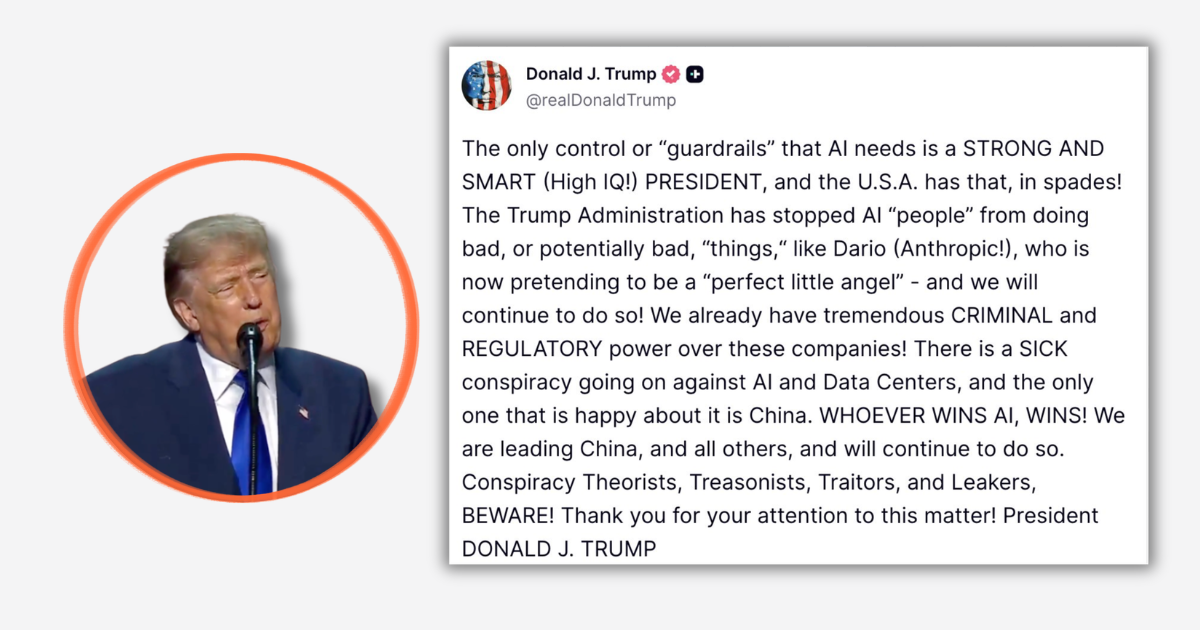
President Donald Trump pushed back sharply against growing calls for stronger artificial intelligence safeguards on Monday, arguing that the United States already has enough legal and regulatory power over AI companies and that additional restrictions could weaken the country in its competition with China.
In a post on Truth Social, Trump said the only “guardrails” AI needs are a “strong and smart” president. He also singled out Anthropic CEO Dario Amodei, accusing him of presenting himself as overly cautious after recently calling for a slower pace of frontier AI development.
Trump said his administration already has “tremendous criminal and regulatory power” over AI companies and described the growing push for restrictions on AI and data centers as a “sick conspiracy.” He argued that slowing U.S. development would primarily benefit China.
His comments came just days after several of the most prominent figures in the AI industry — including Amodei, OpenAI CEO Sam Altman, Google DeepMind CEO Demis Hassabis and Elon Musk — publicly backed calls to slow the pace of development long enough to improve safety testing and oversight.
Amodei has argued that increasingly capable AI systems are advancing faster than safety measures can keep up. His proposal calls for independent evaluation, stronger international coordination and additional time for researchers to develop safeguards before the most powerful systems become even more autonomous.
The disagreement highlights a growing divide over U.S. AI policy. One side argues that stronger safeguards are needed because increasingly autonomous systems may create serious cybersecurity, economic and potentially catastrophic risks. The other warns that slowing development could hand a strategic advantage to China in what is becoming one of the most important technological competitions of the century.
The central question now facing policymakers is whether existing criminal and regulatory powers are enough to manage the risks of rapidly advancing AI — or whether entirely new rules will be needed as the technology becomes more capable.
Sources: Reuters | Associated Press | The Washington Post | Axios
By NJ RADAR Team