


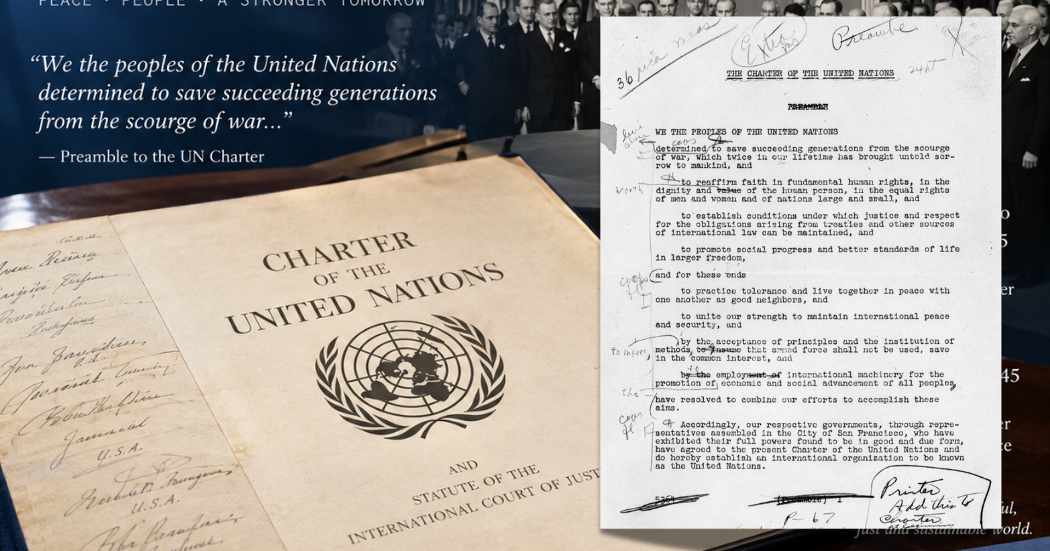
More than 80 years ago, representatives of 50 countries gathered in San Francisco with an ambitious goal: to create an international system that could help prevent another catastrophic global war and establish common rules for relations between states.
The result was the Charter of the United Nations, signed on June 26, 1945. It entered into force on October 24 of that year, the date now observed as United Nations Day.
The Charter is the founding document of the United Nations, but it is also an international treaty that legally binds UN Member States. It established many of the principles that still shape international law and global diplomacy today.
One of its central principles is the sovereign equality of states. Regardless of size, military strength or economic power, UN members are formally equal under the Charter.
The Charter also requires states to settle international disputes by peaceful means, including negotiation, mediation, arbitration and judicial settlement.
One of its most important provisions is Article 2, which prohibits the threat or use of force against the territorial integrity or political independence of another state.
At the same time, the Charter recognizes limited exceptions. Article 51 preserves the right of individual or collective self-defense if an armed attack occurs. Under Chapter VII, the UN Security Council can also authorize measures, including sanctions and, in certain circumstances, the use of force, when it determines that international peace and security are threatened.
The Charter also created the principal organs of the United Nations, including the General Assembly, Security Council, Economic and Social Council, International Court of Justice and Secretariat.
The International Court of Justice in The Hague serves as the UN’s principal judicial body. It settles legal disputes between states and issues advisory opinions on questions of international law.
The Charter also calls for international cooperation on economic, social, cultural and humanitarian issues, as well as respect for human rights and fundamental freedoms.
Its Preamble begins with language shaped directly by the devastation of World War II. It speaks of saving future generations from the “scourge of war,” reaffirming faith in fundamental human rights and human dignity, and creating conditions in which justice and international obligations can be respected.
Since 1945, the Charter has been amended several times, mainly to reflect the growth of UN membership and institutional changes. Its core principles, however, have remained largely unchanged.
The United Nations is again highlighting those principles today, more than 81 years after the Charter was signed in San Francisco.
September 11 is not an official anniversary of the Charter. The UN’s current post is therefore best understood as a renewed reminder of the principles on which the organization was founded: peace, sovereignty, international law, human rights and the peaceful settlement of disputes.
At a time of wars, territorial disputes, geopolitical rivalry and growing pressure on international institutions, the Charter is once again being cited in debates over aggression, self-defense, sovereignty and the role of the Security Council.
More than eight decades after its adoption, the central question is no longer what the Charter says.
The question is how willing states still are to follow the rules they once agreed to uphold.
Sources: United Nations; UN Charter; International Court of Justice
By NJ RADAR Team