


Pope Leo XIV’s first papal visit to France in nearly two decades has drawn enormous crowds and placed several major themes at the center of his message: peace, young people, human dignity and the rapidly growing influence of artificial intelligence.
The four-day visit, from September 25 through September 28, includes stops in Paris, Saint-Denis, Lourdes and Metz, as well as a visit to UNESCO headquarters. It is the first papal visit to France in 18 years.
A Massive Welcome in France
Large crowds followed the Pope throughout the opening days of the visit.
One of the most important events came Friday night at the Stade de France in Saint-Denis, where Pope Leo met thousands of young people for a prayer vigil. The gathering included music, prayer, dialogue and questions from young Catholics about faith, society and their future.
The following day, he celebrated Mass at Place de la Concorde in Paris, one of the largest public events of the trip.
His visit has attracted attention far beyond France’s Catholic community, in part because the Pope has repeatedly connected religious themes with some of the most urgent political, social and technological questions facing the world.
A Message to Young People: Become Builders of Peace
At the Stade de France, Pope Leo urged young people not to respond to division with hatred or violence.
His message focused on hope, responsibility and peace.
He told the young audience that the Christian struggle is not a fight against other people and should never be carried out through violence, contempt or oppression. Instead, he encouraged them to transform fear into hope and frustration into constructive action.
He called on young people to become what he described as “artisans of peace” — people who actively build peace in their communities and relationships.
The message came at a time of continuing wars, political polarization and growing social tension across many parts of the world.
Rather than presenting peace simply as the absence of war, the Pope linked it to personal responsibility, dialogue and the way people treat one another.
Artificial Intelligence and the “Paradise of Machines”
Artificial intelligence has also emerged as one of the defining themes of Pope Leo XIV’s visit.
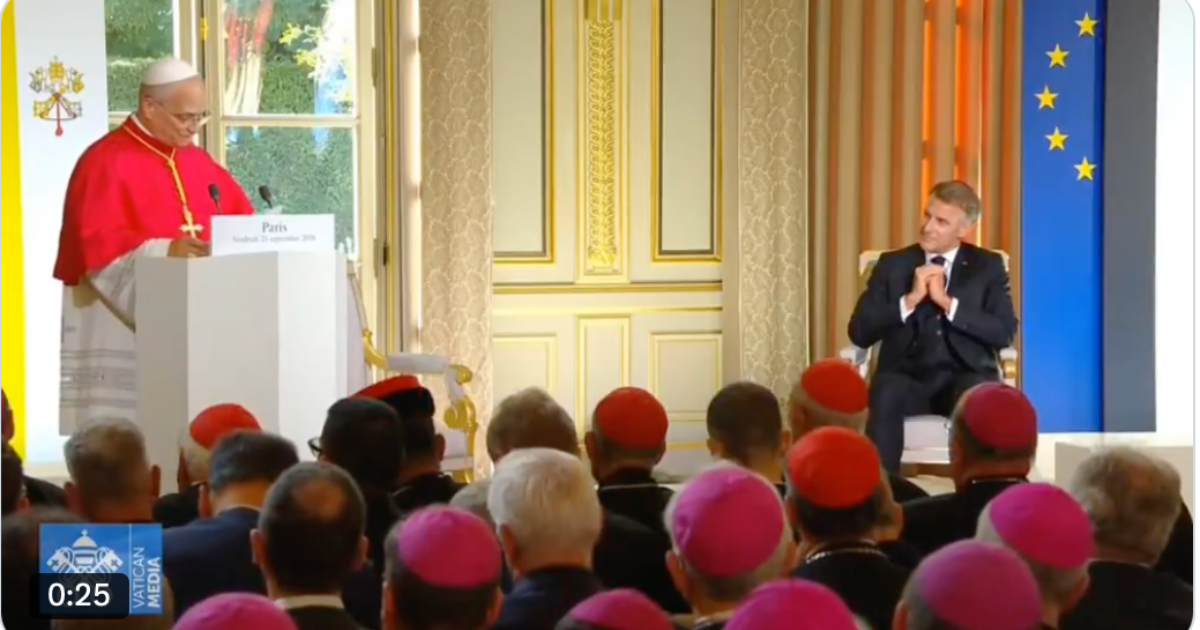
Speaking to French authorities, civil society representatives and diplomats at the Élysée Palace, he warned against allowing technology to place machines at the center of society instead of human beings.
Referencing French writer Georges Bernanos and his warning about a possible “Paradise of Machines,” Pope Leo said the rapid expansion of AI makes ethical education and moral discernment increasingly important.
He said his first encyclical addressed artificial intelligence precisely because he wanted to place the human person back at the center of reflection.
According to the Pope, societies must ensure that technological systems respect human freedom and dignity rather than gradually conditioning or controlling everyday life.
His position is not a rejection of artificial intelligence.
Instead, he has emphasized that AI should remain a tool serving people and the common good, while governments and institutions develop stronger ethical standards and regulation around its use. Reuters reported ahead of the visit that stronger AI governance would be one of the major global issues addressed during his time in France.
Human Dignity as the Common Thread
Peace and artificial intelligence may appear to be very different issues, but Pope Leo has connected them through one central idea: human dignity.
Whether speaking about conflict, technology, migration, young people or social divisions, his message has repeatedly returned to the value of the individual person.
At the Élysée Palace, he warned against social systems that impose uniformity and argued that a genuinely free society must protect different consciences and encourage ethical dialogue.
He also noted that this question is particularly important in France, where people of different religious and cultural backgrounds live together.
A Visit With Several Difficult Subjects
The visit is not centered only on celebration.
Pope Leo is also confronting one of the most difficult issues facing the Catholic Church in France: clerical sexual abuse.
He is scheduled to meet abuse survivors during his visit to Lourdes. A major independent investigation published in 2021 estimated that hundreds of thousands of children had suffered sexual abuse within Catholic institutions in France over several decades. Survivor groups continue to call for deeper reforms and greater accountability.
That issue gives the trip another dimension: alongside messages about peace and technology, the Pope is visiting a Church still trying to rebuild trust.
More Than a Ceremonial Visit
Pope Leo XIV’s trip to France is therefore becoming more than a traditional papal visit.
The massive crowds are the most visible part of the story.
But underneath the public ceremonies is a broader message directed particularly toward younger generations: technological progress should not come at the expense of humanity, political and religious differences should not lead automatically to hostility, and peace requires active participation rather than passive hope.
In Paris, Saint-Denis and beyond, Pope Leo is presenting an argument that links some of the defining challenges of this century.
A world with more powerful technology, he suggests, will still need something technology cannot provide on its own: human judgment, responsibility and the decision to build peace.
Sources: Vatican; Holy See Press Office; Reuters; Associated Press
By NJ RADAR Team