


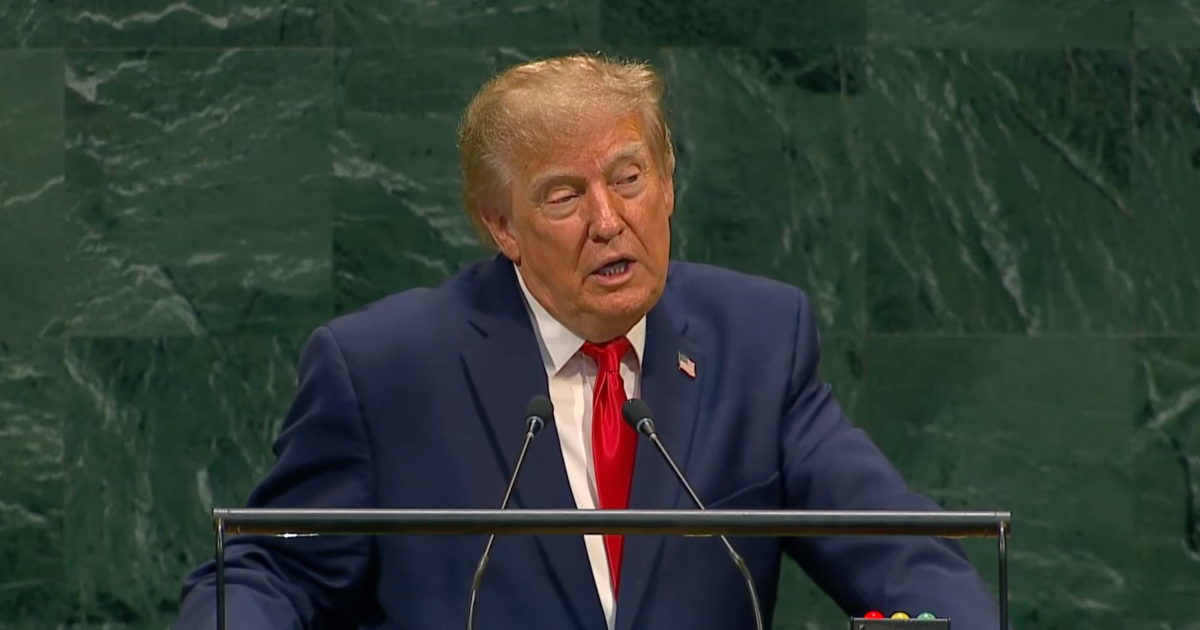
President Donald Trump used his address to the 81st United Nations General Assembly in New York on Tuesday, September 22, to introduce an unusual proposal: stop calling artificial intelligence “artificial intelligence” and instead refer to it as “Super Intelligence,” or SI.
Trump argued that the word “artificial” makes intelligence sound fake, while he described the technology itself as extraordinary. He said U.S. government documents should begin using the term “Super Intelligence” instead. Reuters reported that Trump presented the change as part of a broader argument against slowing the development of AI.
Trump made the announcement at the United Nations
The remarks came during the opening day of the U.N. General Assembly’s annual high-level general debate, where heads of state and government from around the world gather in New York to address global issues. This year’s general debate runs from September 22 through September 28.
During the AI portion of his speech, Trump also rejected efforts to create what he described as a global system for controlling artificial intelligence. He argued that the United States should remain free to develop the technology aggressively and maintain its lead over China and other countries.
“Whoever wins AI, wins”
Trump has repeatedly framed artificial intelligence as an international technological race.
In remarks around the same period, he said:
“Whoever wins AI, WINS!”
He said the United States is currently ahead of China and that he does not want regulation to “stifle growth” in a technology he believes could ultimately be more consequential than either the Industrial Revolution or the internet. Reuters reported that Trump said the Justice Department and other federal law-enforcement bodies could intervene if necessary, but that his general approach would be to encourage AI development rather than slow it.
Why the name change is unusual
There is an important technical complication.
“Artificial intelligence” and “superintelligence” are not normally interchangeable terms.
Artificial intelligence is the broad term used for computer systems capable of tasks associated with human intelligence, including language, reasoning, image recognition and prediction.
By contrast, superintelligence is generally used in AI research to describe a hypothetical future system that would surpass human intellectual abilities across a very broad range of tasks.
That means using “Super Intelligence” as a general replacement for AI could create confusion between today’s technology and a much more advanced theoretical form of intelligence.
Is AI officially being renamed?
Trump said that U.S. government documents would begin using the new terminology, but his speech itself does not change the terminology used by scientists, universities, technology companies or the rest of the world.
It also remains to be seen how broadly federal agencies will actually implement the change and whether “SI” will appear consistently in future government policies and documents.
For now, AI remains the universally recognized term, while “Super Intelligence” is the terminology Trump says he wants his administration to adopt.
A much larger debate behind the name
The name may attract attention, but Trump’s more consequential message was about policy.
He used the U.N. stage to make clear that his administration opposes international restrictions that it believes could slow American AI development. At the same time, he acknowledged that AI could require government intervention if serious problems emerge.
That puts two competing priorities at the center of the debate: maintaining U.S. technological leadership while deciding how much oversight is necessary for increasingly powerful systems.
Whether the term “Super Intelligence” catches on is another question.
For now, Trump has given one of the world’s most familiar technological acronyms a proposed replacement:
AI could become SI — at least in the language of his administration.
Sources: Reuters, United Nations, S Clash Report, via X.
By NJ RADAR Team