


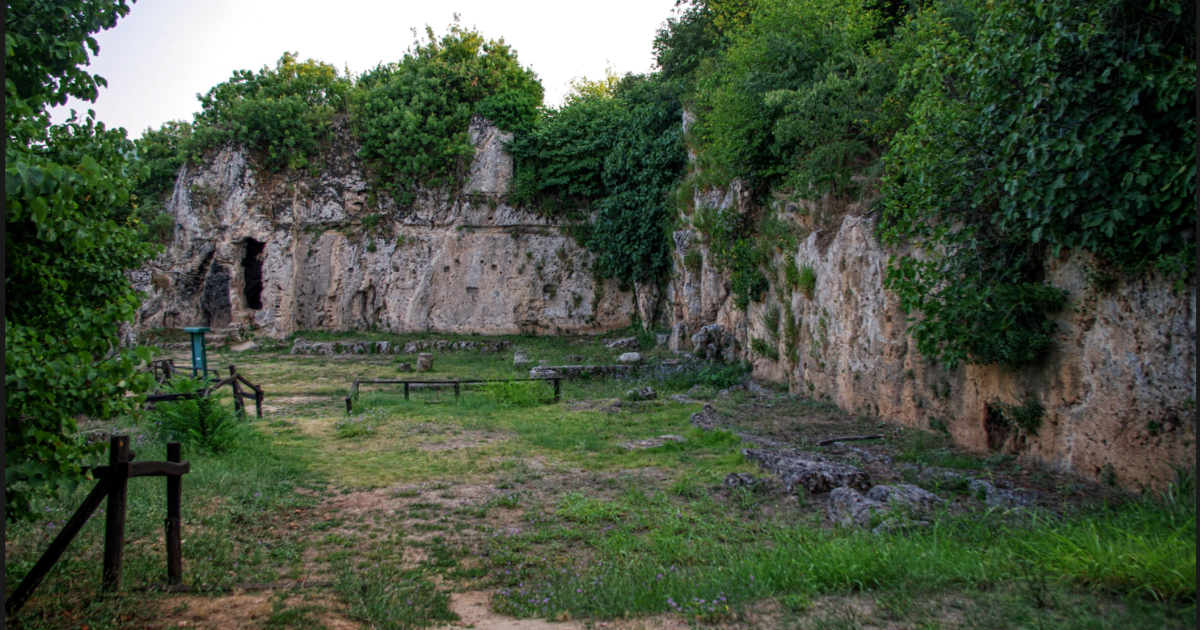
Archaeologists in northern Greece are uncovering new details about a remarkable place connected to one of history’s most famous teacher-student relationships: the Royal Gymnasium of ancient Mieza, where Aristotle is believed to have taught the young Alexander the Great more than 2,300 years ago.
The monumental complex near modern-day Naousa dates to the middle of the fourth century BCE, during the reign of Philip II of Macedon. According to Greece’s Ministry of Culture, recent excavations led by archaeologist Angeliki Kottaridi have strengthened the identification of the site as the gymnasium associated with Aristotle, Alexander and other young members of the Macedonian elite.
The scale of the site suggests that this was far more than a small classroom. Archaeologists have identified parts of a palaestra used for physical training, a stadium, long covered porticoes, water installations and spaces associated with teaching and communal life. The gymnasium extended across several hectares, combining intellectual education with the physical preparation expected of young Macedonian nobles.
Recent work has added another layer to the picture. Excavations on the eastern side of the complex revealed rooms with stone benches that appear to have been used for instruction, as well as two banquet halls with mosaic floors whose construction closely resembles work found at the royal palace of Aigai. Each hall contained raised areas for dining couches, indicating that education at Mieza also included the social and ceremonial world of the Macedonian court.
Among the smaller finds are four bronze writing styluses. Their presence provides tangible evidence of writing and study at the gymnasium. Archaeologists have suggested that such objects may have been used by students there, although there is no evidence that any particular stylus belonged personally to Alexander.
A remarkable chain of teachers
The story of Mieza becomes even more fascinating when Alexander’s education is placed within one of the most famous intellectual lineages in Western history:
Socrates taught Plato. Plato taught Aristotle. Aristotle taught Alexander the Great.
Socrates, who left no writings of his own, profoundly influenced his student Plato. Plato later founded the Academy in Athens, where Aristotle studied for roughly two decades.
Aristotle eventually left Athens and, in 343 BCE, was invited by Philip II of Macedon to oversee the education of his young son Alexander and other sons of prominent Macedonian families. The Greek Ministry of Culture notes that Alexander was about 13 years old when Aristotle was brought to Mieza.
Philip II himself was not Aristotle’s student. He was the king who selected the philosopher to educate his son.
That creates an extraordinary historical sequence stretching across generations:
Socrates → Plato → Aristotle → Alexander the Great
Ideas transmitted through teachers and students in Athens eventually reached a teenage Macedonian prince who would go on to build an empire extending from Greece and Egypt deep into Asia.
Alexander was not Aristotle’s only pupil at Mieza. Ancient traditions associate the group with young Macedonian nobles who later became important figures in Alexander’s campaigns and in the kingdoms that emerged after his death.
The connection also had deeper roots. Aristotle’s father, Nicomachus, had served as physician to Amyntas III of Macedon, the father of Philip II and grandfather of Alexander. Aristotle therefore came from a family already connected with the Macedonian royal court.
More than an archaeological site
For centuries, the story of Aristotle teaching Alexander at Mieza was known primarily through ancient written sources, especially Plutarch. Archaeological work is now allowing researchers to reconstruct the physical environment in which that education may have taken place.
The older Nymphaeum at Mieza was traditionally identified as “Aristotle’s School,” but newer research increasingly points toward the much larger Royal Gymnasium as the principal educational complex connected with Alexander and his companions. Cultura Legnatia
The excavations are continuing. Greece’s Ministry of Culture says the new discoveries are helping archaeologists understand not only the architecture of the gymnasium but also the way young Macedonians were educated and prepared for leadership during the age of Philip II. Ministarstvo kulture
More than two millennia later, Mieza offers an unusual physical link between philosophy and political history — a place where a line of ideas that passed from Socrates to Plato to Aristotle reached a young Alexander before he became known to history as Alexander the Great.
Sources: Greek Ministry of Culture, Cultural Egnatia – Ministry of Culture, Archaeology Magazine, Kathimerini
By NJ RADAR Team