


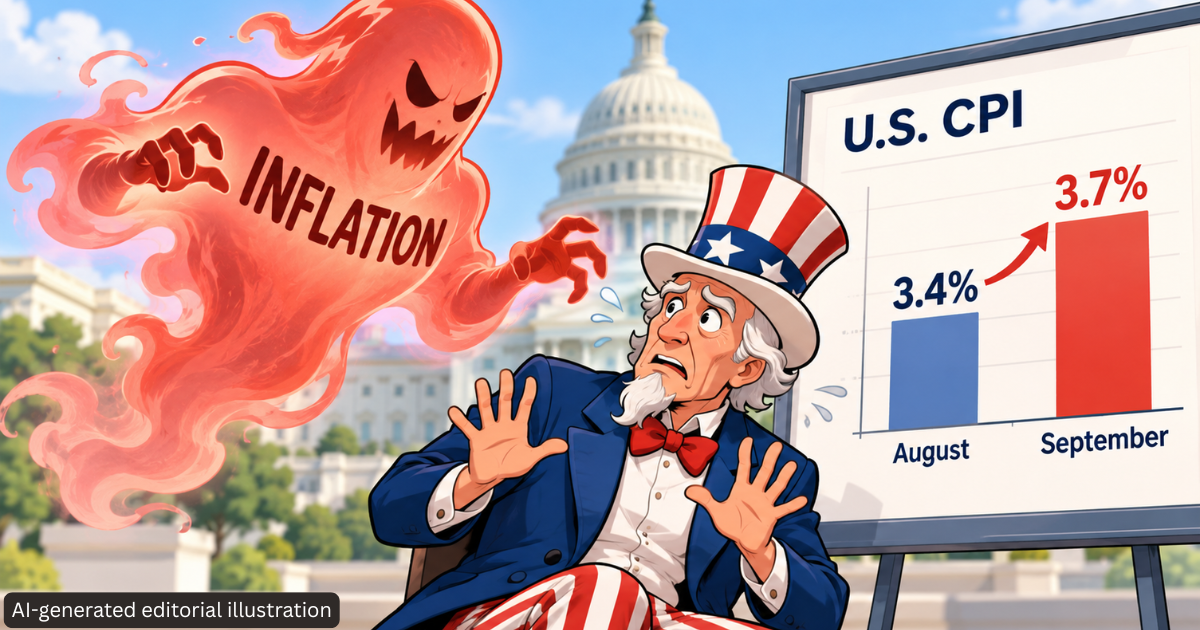
Consumer prices rose sharply in September, driven by surging energy costs. The latest inflation report delivers another blow to American households and raises the possibility of higher interest rates.
WASHINGTON, D.C. — October 14, 2026 — Inflation in the United States accelerated to 3.7% in September, exceeding economists’ expectations and adding new pressure on American families already struggling with the rising cost of living.
According to figures released Wednesday morning by the U.S. Bureau of Labor Statistics, consumer prices increased 0.6% in September alone, following a 0.4% rise in August.
The annual inflation rate climbed from 3.4% in August to 3.7% in September, its highest level in five months.
The biggest driver was a sharp increase in energy prices, particularly gasoline, which jumped 9.1% in a single month.
The report offers a troubling reminder that inflation is not simply an economic statistic. It directly affects how much families pay to commute to work, heat their homes, purchase necessities, and manage their monthly budgets.
Gasoline Prices Drive the Inflation Surge
Energy prices played the largest role in September’s inflation increase.
The Bureau of Labor Statistics reported that gasoline prices climbed 9.1% during the month, accounting for more than half of the overall monthly increase in consumer prices.
Compared with September 2025, gasoline prices were 34.2% higher.
The broader energy index rose 5.2% in September and 20.4% over the previous 12 months.
Fuel oil prices were particularly striking, increasing 15.3% in September and 74.2% compared with a year earlier.
Economists have linked much of the increase to disruptions in global energy markets associated with the conflict involving Iran and concerns about oil supplies.
For millions of Americans who depend on their vehicles to get to work, school, and medical appointments, higher gasoline prices represent an expense that is difficult to avoid.
For New Jersey residents, many of whom commute daily by car or depend on transportation services, rising fuel costs can quickly translate into higher household expenses.
Inflation Is Spreading Beyond Energy
While gasoline accounted for much of September’s increase, the report also showed price pressures in other parts of the economy.
Core inflation, which excludes food and energy because of their volatility, rose 0.3% in September and reached 2.6% over the previous year.
Housing-related costs also continued to increase. The shelter index rose 0.4% during September and 3.2% over 12 months.
Airline fares were 22.4% higher than a year earlier, while education costs increased 3.8%.
These figures indicate that inflation is not confined to gas stations.
Households face higher costs across multiple categories, even as certain prices remain stable or decline.
Grocery Prices Offer Limited Relief
There was one modest positive sign in the report.
Overall food prices were unchanged in September, while prices for groceries purchased for home consumption declined 0.1%.
However, restaurant and other food-away-from-home prices rose 0.2%.
Compared with a year earlier, overall food prices remained 2.5% higher.
The monthly decline in grocery prices therefore does not mean food has returned to previous price levels.
For consumers, the distinction matters: slower inflation means prices are rising less quickly, not necessarily falling.
Americans Are Losing Purchasing Power
One of the most concerning aspects of the latest inflation report is its effect on wages.
Inflation-adjusted earnings have declined, meaning many workers are finding that their paychecks purchase less than before.
Real average hourly earnings fell 0.5% from August to September and were 0.7% lower than a year earlier.
For families whose wages are not keeping pace with prices, rising expenses force difficult decisions.
A larger share of income may go toward transportation, housing, and utilities, leaving less available for savings, education, medical needs, and emergencies.
The consequences can be particularly serious for lower-income households and retirees living on fixed incomes.
Federal Reserve Faces Pressure to Raise Interest Rates
The inflation report also creates a difficult decision for the Federal Reserve.
The central bank aims to maintain inflation around 2%, but September’s 3.7% reading shows that price growth remains substantially above that objective.
Following the release, financial markets increased expectations that the Federal Reserve could raise interest rates at its October 27–28 meeting.
Higher interest rates can help slow inflation by reducing borrowing and spending, but they also make mortgages, car loans, credit cards, and business financing more expensive.
That creates a difficult balance for policymakers.
Acting too aggressively could weaken economic growth and employment. Acting too slowly could allow inflation to remain elevated.
No decision on the October interest rate has yet been announced.
A Political Challenge Ahead of the Midterm Elections
The report arrives just weeks before the November 2026 midterm elections, with affordability and the cost of living among the major concerns facing American voters.
The Trump administration is facing renewed scrutiny over its handling of the economy as rising fuel costs and declining purchasing power affect households across the country.
Although global energy disruptions are an important factor behind the recent price increases, the economic consequences are being felt directly by American consumers.
The latest inflation figures are likely to intensify debate over energy policy, government spending, interest rates, and the administration’s broader economic strategy.
What the Numbers Mean for New Jersey
For New Jersey households, the national report carries several important implications.
Gasoline costs affect commuting expenses, particularly for residents who travel regularly to New York City or across the state.
Higher transportation and energy costs can also place pressure on businesses, potentially affecting the prices consumers pay for goods and services.
Housing remains another major concern in a state where many residents already face substantial rental and homeownership expenses.
The national inflation rate does not describe every individual household’s experience, but it provides an important measure of the broader economic pressures affecting New Jersey families.
Prices Are Still Rising — and Families Feel the Difference
A 3.7% annual inflation rate means that the overall consumer price index was 3.7% higher than it was one year earlier.
It does not mean that prices increased by only 3.7% over the past several years, nor that consumers have recovered purchasing power lost during previous periods of inflation.
For households, the most important measure is often not the inflation rate itself, but how much money remains after essential bills have been paid.
September’s report shows that the United States is still struggling to bring inflation under control, with energy prices creating a new wave of pressure on consumers.
For American families, the latest inflation numbers deliver a simple but painful message: everyday life is becoming more expensive, and household budgets are being stretched even further.
Sources:
- U.S. Bureau of Labor Statistics — Consumer Price Index, September 2026, released October 14, 2026
- Associated Press — Inflation Report, October 14, 2026
- Reuters — U.S. Inflation and Federal Reserve Outlook, October 14, 2026
- Financial Times — U.S. Inflation and Energy Prices, October 14, 2026
By NJ RADAR Team