


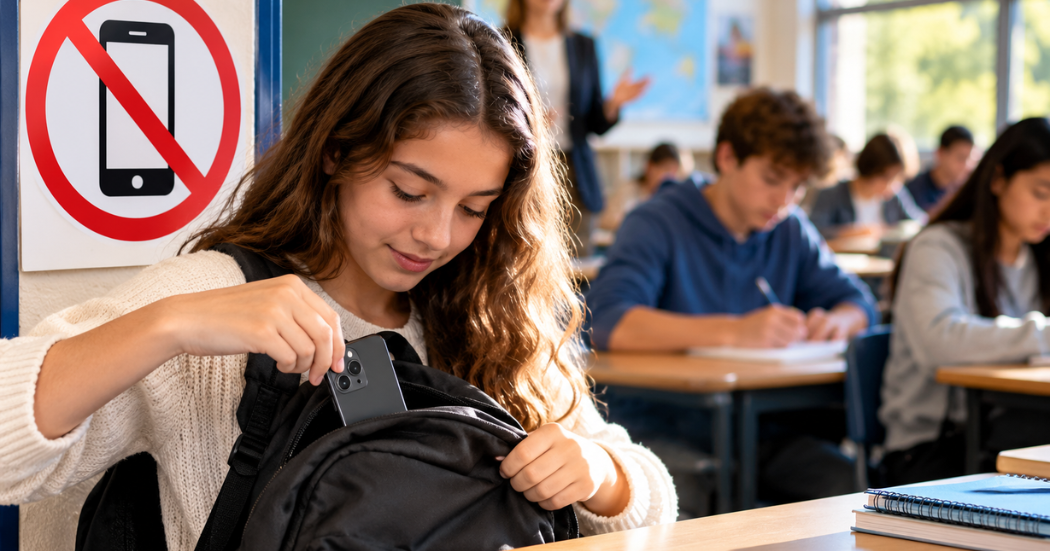
New Rutgers-Eagleton survey reveals overwhelming support for the state’s new school cellphone restrictions, with strong backing among parents, older residents, Democrats, Republicans, and independents.
NEW JERSEY — October 12, 2026 — More than eight in ten New Jersey residents support the statewide ban on non-academic cellphone use in public schools, according to a new Rutgers-Eagleton Poll released Monday.
The survey found that 83% of New Jersey adults support the policy, which took effect at the beginning of the 2026–2027 school year and applies to students from kindergarten through 12th grade.
Of those surveyed, 59% strongly support the restrictions and another 24% somewhat support them. Only 13% oppose the ban, while 4% remain uncertain.
The results reveal an unusually broad level of public agreement on an education policy that affects hundreds of thousands of students across the state.
Strong Support Across Generations
Although the ban is popular across all age groups, the survey found significant generational differences.
Among residents aged 65 and older, support reaches 94%, making them the strongest supporters of the policy.
Support stands at 85% among adults aged 50 to 64, 81% among those aged 35 to 49, and 72% among younger adults aged 18 to 34.
Even among the youngest adults surveyed, nearly three out of four favor restricting cellphone use during the school day.
Ashley Koning, director of the Eagleton Center for Public Interest Polling at Rutgers University–New Brunswick, said the findings show that the policy has support across virtually every demographic group, with the most noticeable differences appearing between generations.
Parents Also Favor the Restrictions
The survey found that 80% of parents and guardians with children under 18 support the ban.
Among residents without minor children, support is slightly higher at 84%.
The relatively small difference suggests that public approval is not limited to people without school-age children. Families directly affected by the rules also largely support them.
The poll additionally found that the policy enjoys similar support across political affiliations: 87% among Republicans, 85% among Democrats, and 79% among independents. These differences fall within the survey’s margin of error.
What Does New Jersey’s Cellphone Ban Require?
The statewide policy, signed into law by former Governor Phil Murphy in January 2026, requires public schools to restrict students’ non-academic use of cellphones and other personal internet-connected devices throughout the school day.
Known as a bell-to-bell policy, the restrictions apply from the beginning of the school day until dismissal, including time between classes.
School districts have flexibility in deciding how to enforce the rules. Some use locking cellphone pouches, while others require students to keep their devices turned off in backpacks or lockers.
The policy includes exceptions for emergencies, medical needs, certain educational accommodations, translation services, and other circumstances permitted under state guidance.
The restrictions are intended to reduce classroom distractions, strengthen student engagement, and support students’ mental well-being.
Will the Ban Improve Learning?
Supporters of cellphone restrictions argue that constant access to social media, messaging, and online entertainment can interfere with concentration and face-to-face interaction.
New Jersey education officials have emphasized that the goal is not to eliminate technology from education, but to create a school environment where personal devices do not constantly compete for students’ attention.
Rutgers researchers have also studied the relationship between adolescent social media use, school experiences, and student well-being.
However, while public support for the ban is strong, its long-term effects on academic performance, school culture, and mental health will require further evaluation.
About the Rutgers Survey
The Rutgers-Eagleton Poll surveyed 1,004 adults across New Jersey between September 24 and September 27, 2026.
The survey was conducted through the probability-based Rutgers-Eagleton/SSRS Garden State Panel and has a margin of error of plus or minus 4.1 percentage points.
The results suggest that, despite differences in age, income, education, and political affiliation, New Jersey residents largely agree on one issue: personal cellphones should not interfere with the school day.
For schools now implementing the restrictions, the next question is whether this broad public support will translate into measurable improvements in student learning, concentration, and well-being.
Sources: Rutgers-Eagleton Poll, October 12, 2026 | Rutgers University | New Jersey Department of Education | New Jersey Monitor
By NJ RADAR Team
[…] Following a Rutgers poll showing overwhelming support for New Jersey’s school cellphone restrictions, Governor Mikie Sherrill highlights efforts to reduce digital distractions, strengthen online protections, and expand mental health support for students. […]