


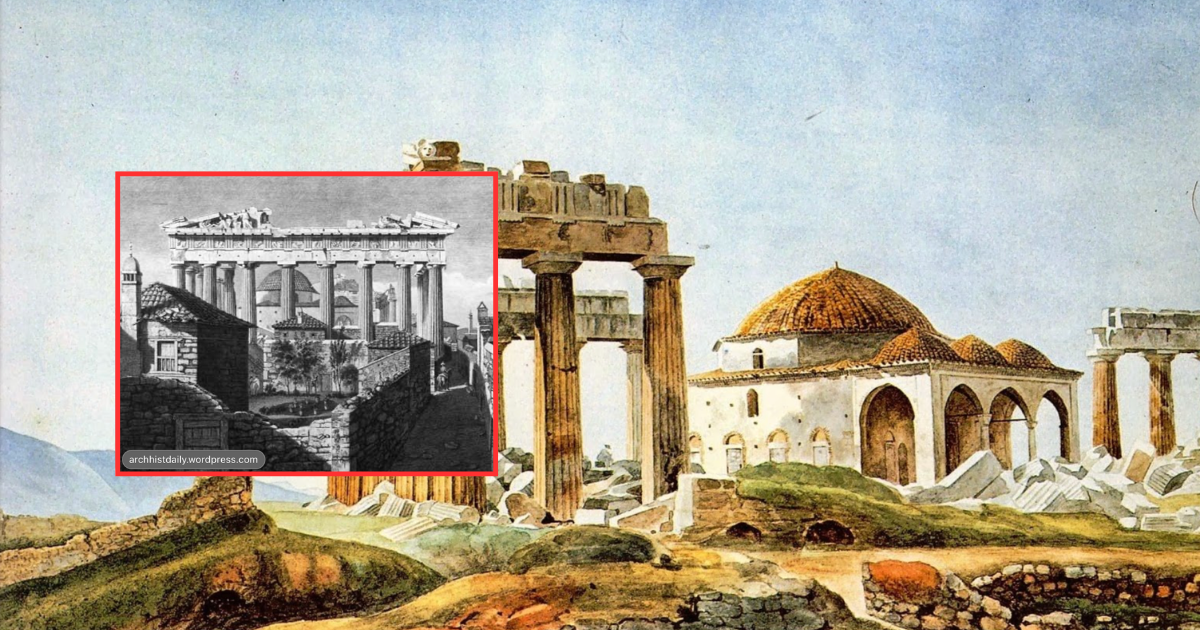
ATHENS, GREECE — One of the earliest known photographs of the Parthenon reveals a surprising detail from the monument’s complex history: a small Ottoman mosque standing among the ruins of one of the world’s most famous ancient Greek temples.
The historic image, captured in 1839 by French-Canadian photographer Pierre-Gustave Joly de Lotbinière, offers a rare glimpse of a structure that disappeared just a few years later.
Today, the Parthenon is celebrated as a symbol of ancient Greek civilization. But over its nearly 2,500-year history, the building has undergone remarkable transformations, serving as a Greek temple, a Christian church, and later a mosque.
A Mosque Among Ancient Ruins
The Parthenon was originally constructed in the fifth century BCE as a temple dedicated to Athena, the patron goddess of Athens.
During the Byzantine period, it was converted into a Christian church. Following the Ottoman conquest of Athens in the 15th century, the building became a mosque.
In 1687, during the Morean War, Venetian forces bombarded the Acropolis. Ottoman troops had stored gunpowder inside the Parthenon, and a direct hit caused a devastating explosion that destroyed much of the ancient structure.
A smaller Ottoman mosque was subsequently built within the surviving ruins, probably in the late 17th or early 18th century.
It is this modest building that appears in the remarkable 1839 image.
A Photograph That Preserved a Disappearing Past
Pierre-Gustave Joly de Lotbinière visited Athens in 1839, shortly after the invention of the daguerreotype photographic process was publicly announced.
On October 9, he captured what is widely considered the earliest known photographic view of the Parthenon.
The image shows the ancient columns and damaged walls surrounding a small building topped by a dome — the Ottoman mosque.
By that time, the mosque was no longer functioning as a place of worship. It had been repurposed to house archaeological discoveries from the Acropolis.
The historic scene survives through a well-known engraving by Frédéric Martens, based on Joly de Lotbinière’s daguerreotype.
Why Was the Mosque Removed?
Following Greek independence from Ottoman rule, the new Greek state sought to reshape the Acropolis as a symbol of ancient Greek civilization and national identity.
This process involved more than archaeological restoration. It also reflected a broader effort to distance the country’s public monuments from its Ottoman past.
Across Greece, numerous Ottoman mosques were demolished, abandoned, closed to worship, or converted to other uses.
The small mosque inside the Parthenon was demolished in 1843, during the early archaeological transformation of the Acropolis.
While the removal was associated with efforts to restore the site’s classical appearance, it also resulted in the permanent loss of a visible part of the monument’s Ottoman and Islamic history.
One Monument, Many Civilizations
The Parthenon’s long history illustrates how places of worship and cultural landmarks can acquire different meanings across centuries.
Originally dedicated to Athena, it later became a Christian church, then an Ottoman mosque, before eventually becoming one of the world’s most recognizable archaeological monuments.
The 1839 image is a rare reminder that the Acropolis was not frozen in the classical era. It continued to evolve through successive civilizations, religions, conflicts, and political transformations.
Nearly two centuries later, the small mosque visible among the ruined columns tells a story that many visitors to the Parthenon may never have heard.
Sometimes, a single photograph preserves a chapter of history that has vanished from the landscape.
Sources: Pierre-Gustave Joly de Lotbinière historical daguerreotype, Wikimedia Commons, Acropolis Museum, Encyclopaedia Britannica, Today in History / X.
By NJ RADAR Team