


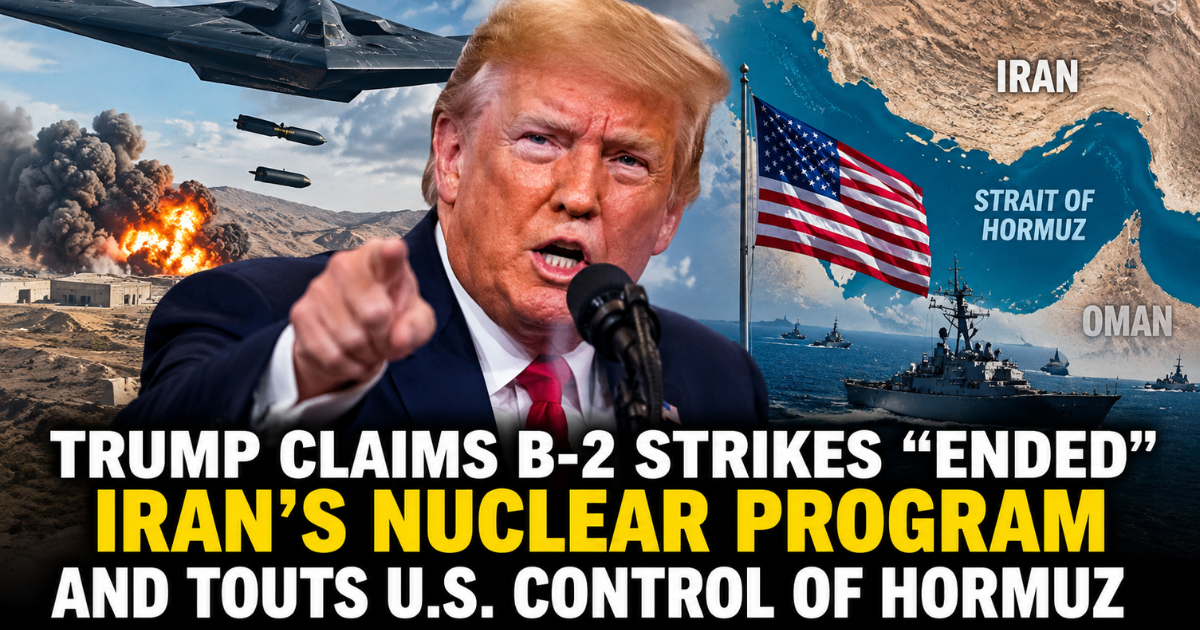
President Donald Trump is again claiming that U.S. B-2 bomber strikes effectively ended Iran’s nuclear program, while also portraying American military power as having secured control over the Strait of Hormuz.
“We really ended Iran as soon as the B-2 bombers hit because that was the end of their nuclear,” Trump said.
His statement reflects the administration’s position that the U.S. bombing campaign severely damaged Iran’s nuclear capabilities. Independent assessments, however, have been more cautious about how completely Iran’s nuclear infrastructure was destroyed, and Iran continues to deny that it was pursuing a nuclear weapon.
Trump Presents B-2 Strikes as Decisive
The B-2 Spirit stealth bombers have played a major role in U.S. operations against Iran because they can carry some of America’s heaviest precision-guided bunker-busting weapons.
Trump has repeatedly described those strikes as the decisive moment in the conflict, arguing that they eliminated the nuclear threat that Washington says it was trying to prevent.
The White House has also defended Trump’s recent rhetoric about Iran by arguing that U.S. military action was intended to prevent Tehran from developing the ability to threaten American cities.
Hormuz Remains at the Center of the Conflict
Trump has also used increasingly sweeping language about American power in the Strait of Hormuz, the narrow waterway through which roughly one-fifth of global oil shipments normally pass.
But the Strait does not legally “belong” to the United States. It lies between Iran and Oman and is an international shipping route.
Iran said as recently as October 4 that it would not fully reopen the Strait until conditions contained in negotiations with Washington are met.
The disruption has had major economic consequences. Reduced traffic through Hormuz has contributed to higher global oil prices and rising gasoline costs in the United States.
U.S. Military Pressure Continues
The security situation surrounding Iran remains tense despite Trump’s claims that the conflict is nearing an end.
U.S. officials recently removed B-1 bombers from RAF Fairford in Britain after intelligence indicated a possible Iranian-linked drone threat against the base. British police have since made additional arrests as part of that investigation, while Iran denies involvement.
At the same time, diplomatic negotiations over Hormuz and Iran’s nuclear program remain unresolved.
Trump’s latest comments therefore underline a broader message he has repeated throughout the conflict: that overwhelming U.S. military force has fundamentally weakened Iran and shifted control of the regional balance toward Washington.
Whether that assessment proves lasting will depend in part on Iran’s remaining nuclear capabilities, the reopening of Hormuz and the outcome of continuing negotiations.
Sources: Reuters; Associated Press; Clash Report
By NJ RADAR Team