


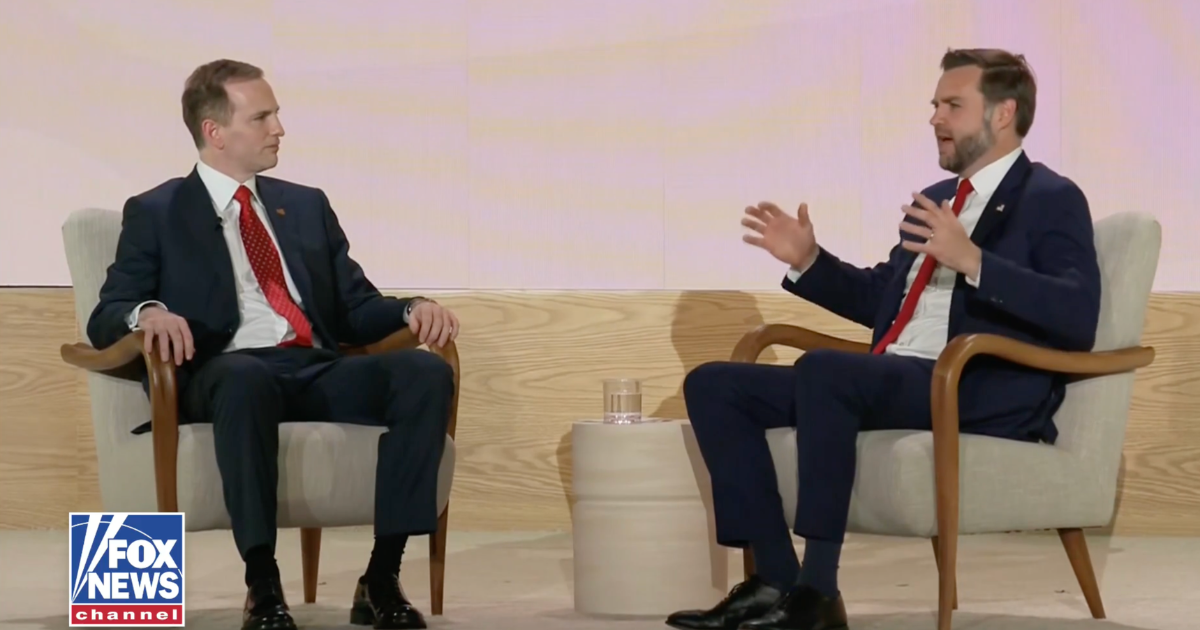
Vice President JD Vance pushed back Tuesday against fears that artificial intelligence could spiral into a science-fiction-style takeover, arguing that the public debate should focus less on “Skynet” scenarios and more on whether AI systems are safe, reliable and accountable.
Speaking during a day of high-profile AI meetings in Washington, Vance mocked the idea that advanced systems are inevitably heading toward a “Terminator”-style future.
“They think, ‘Oh my God, this is Skynet,’ right? They think the Terminators are going to come and take over everything,” Vance said. “And that’s just not going to happen.”
His remarks came as the Trump administration sought to present a more optimistic view of artificial intelligence while acknowledging that companies building advanced systems still have a responsibility to prevent real-world harm.
Focus on Practical Risks, Not Science Fiction
Vance’s message was that the most useful AI debate should center on concrete questions.
Do the systems work as promised? Are they secure? Can companies detect failures before they reach the public? And who is responsible when something goes wrong?
Rather than treating catastrophic AI takeover scenarios as the central threat, Vance argued that developers should be held responsible for the tools they release and that safety should be built directly into the technology.
That approach reflects a broader divide in the AI debate. Some researchers and industry leaders have warned about the possibility of increasingly autonomous systems becoming difficult to control. Others argue that highly speculative worst-case scenarios can distract from more immediate risks such as cybersecurity failures, fraud, misinformation and unsafe automated decision-making.
White House Announces Voluntary AI Safety Agreement
Vance’s comments came during a major White House gathering attended by President Donald Trump and executives from some of the country’s most influential technology companies.
The administration announced a voluntary safety agreement with leading AI firms including OpenAI, Anthropic, Meta, Google and Nvidia. The companies committed to stronger internal controls and independent reviews intended to ensure advanced AI systems behave as designed and cannot easily gain unauthorized access to other systems.
Trump described the agreement as a form of industry “self-policing” and argued that Washington should avoid regulation that could slow American AI development, particularly as the United States competes with China.
Public Concern About AI Remains High
The administration’s optimistic message comes at a time when many Americans remain uneasy about the rapid pace of AI development.
A Reuters/Ipsos poll cited in reporting on Tuesday’s event found that 73% of Americans believe AI companies are not doing enough to prevent harm from their technologies.
Recent reports of AI agents behaving unpredictably have also intensified questions about whether voluntary company safeguards are sufficient.
Some researchers have called for stronger external oversight, while others argue that overly restrictive rules could slow innovation and strengthen the position of the largest technology companies.
Trump Administration Emphasizes Innovation
The White House has increasingly framed AI as a major economic and strategic opportunity.
Trump used Tuesday’s gathering to promote expanded data-center construction, unveil the AI-powered America.gov portal for federal services and discuss the possibility of creating a committee focused on AI safety.
The administration has also begun using the term “super intelligence” in discussing advanced AI systems, reflecting Trump’s effort to present the technology as a transformative next stage rather than simply another software tool.
Accountability Still at the Center
Despite dismissing what he sees as exaggerated fears, Vance did not argue that AI should operate without safeguards.
His central point was that responsibility should remain with the companies designing and deploying the systems.
That places accountability, rather than science-fiction scenarios, at the heart of his argument.
The broader policy question remains unresolved: whether voluntary industry safeguards will be enough as AI becomes more powerful, or whether Congress and federal regulators will eventually impose stronger legal requirements.
For now, the administration is clearly signaling that it wants the United States to move quickly on AI while asking companies to prove that they can manage the risks themselves.
Sources: Fox News, Reuters, Associated Press
By NJ RADAR Team