


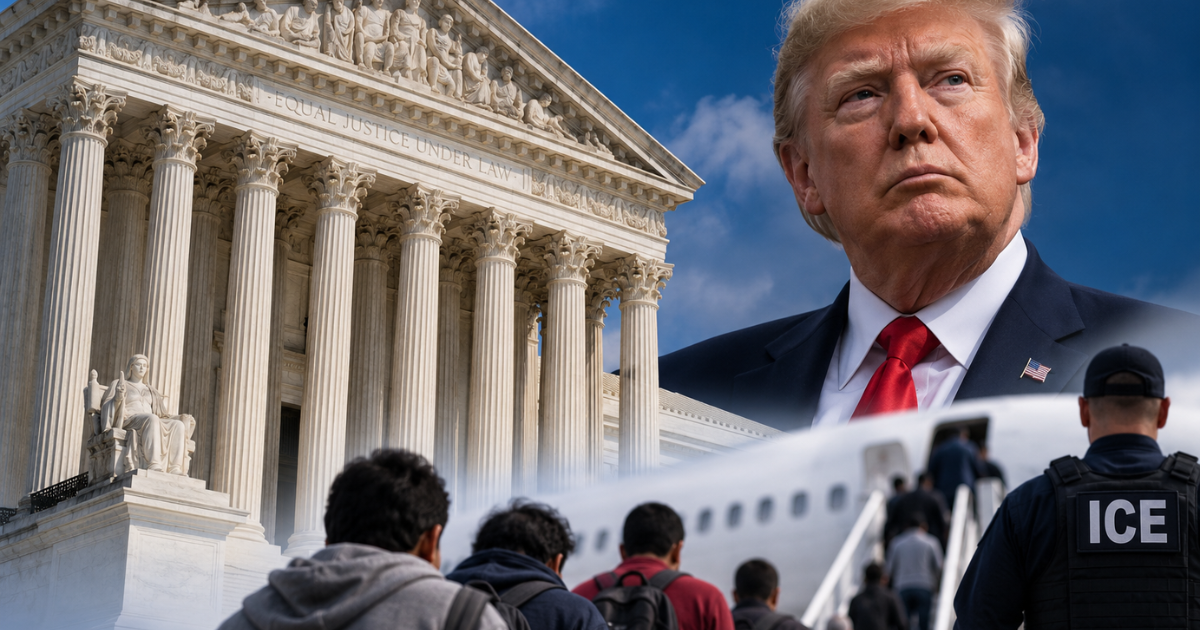
The U.S. Supreme Court on Tuesday allowed the Trump administration to resume deporting some migrants to countries other than their own while a major legal challenge to the policy continues.
The decision temporarily lifts restrictions imposed by lower courts that required the government to give migrants advance notice and an opportunity to explain whether they could face persecution, torture or other serious harm in the country selected for their removal. Reu
The Supreme Court has not yet ruled that the policy itself is lawful. The justices agreed to hear arguments in the case later this year.
What Are “Third-Country Deportations”?
Normally, deportation is associated with returning a person to their country of citizenship or another country with which they have a connection.
The policy at the center of the case allows the federal government, under certain circumstances, to remove a migrant to a third country willing to accept that person.
That means someone could potentially be deported to a country where they are not a citizen and may never have lived.
Federal law provides a sequence of possible destinations when removal to a migrant’s preferred country or country of nationality is not possible. The legal dispute centers in part on what protections must be provided when the government ultimately chooses another country.
More Than 25,000 Third-Country Deportations
According to Reuters, the Trump administration has already used third-country removals for more than 25,000 migrants since the policy was implemented.
Most have reportedly been sent to Mexico, while other destinations have included countries such as South Sudan and Uganda.
The administration argues that the policy is an important enforcement tool, particularly when a migrant’s home country will not accept the person or when another destination is available.
Lower Courts Required Additional Protections
The case, D.V.D. v. Department of Homeland Security, has been moving through federal courts for months.
A federal district judge ruled that migrants facing third-country removal should have advance notice and a meaningful opportunity to raise concerns about possible persecution or torture.
The First U.S. Circuit Court of Appeals later rejected the administration’s effort to quickly restore the broader deportation policy.
The Trump administration then asked the Supreme Court to intervene, arguing that the lower courts had improperly restricted the executive branch’s ability to enforce immigration law.
Human Rights Concerns at Center of Case
Immigration lawyers and human-rights advocates argue that sending people to unfamiliar countries without allowing them to raise safety concerns could expose some migrants to persecution, abuse or torture.
More than a dozen United Nations human-rights experts called on the United States this week to halt third-country deportations that they said could place migrants at heightened risk.
The administration disputes those criticisms and says third-country removals are lawful and necessary to carry out final deportation orders.
Supreme Court Decision Is Temporary
Tuesday’s action does not settle the underlying legal dispute.
For now, it allows the administration to resume the program while the Supreme Court prepares to hear arguments over whether the government can carry out these removals without the procedural protections required by the lower courts. Reuters
The eventual ruling could have significant implications for immigration enforcement because it will help determine what legal protections migrants must receive before the United States sends them to countries other than their own.
Until then, third-country deportations can resume under the administration’s policy.
Sources: U.S. Supreme Court, Reuters, United Nations human rights experts
By NJ RADAR Team