


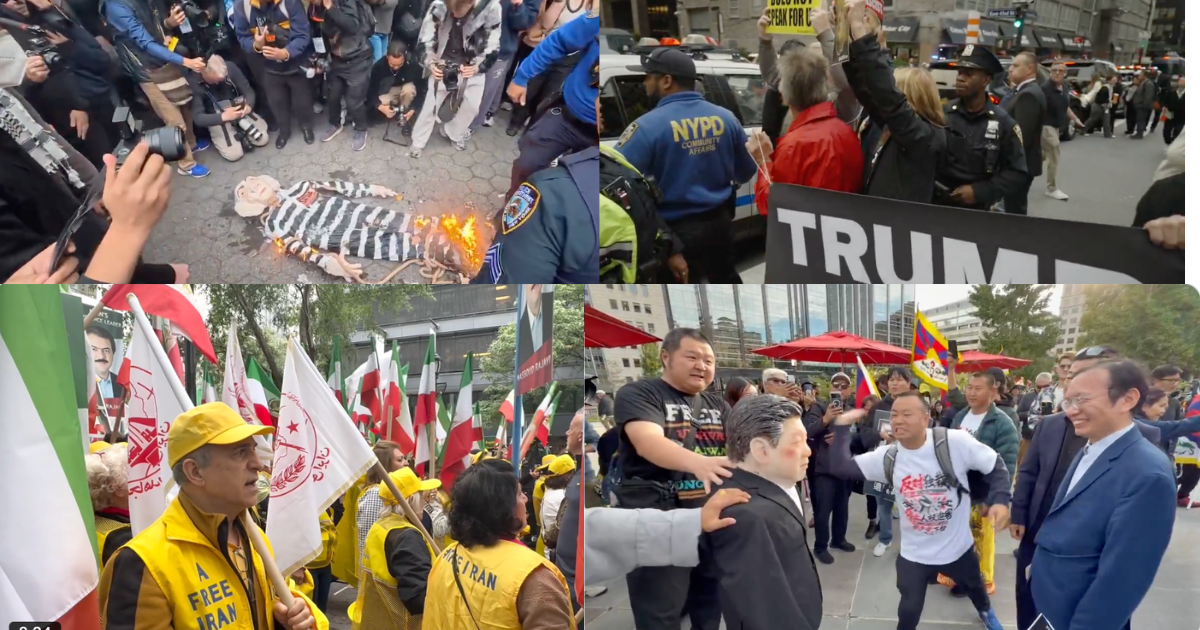
This week, America welcomed presidents, prime ministers, diplomats and ministers from nearly every part of the world as they gathered for the United Nations General Assembly. While world leaders entered the halls of the UN, delivered carefully prepared speeches, met behind closed doors and posed for cameras, another kind of diplomacy was unfolding on the streets of New York and Washington.
Louder. Messier. Far less controlled.
Banners, chants, blocked intersections, arrests, effigies of political leaders, improvised performances and occasional moments of almost dark humor turned UN week into a parallel stage where citizens, activists, diaspora communities and political opponents tried to deliver their own messages to the leaders visiting the United States.
But the protests did not remain only in the streets.
The General Assembly hall itself became a stage for political protest several times. Delegations used walkouts and absences to register opposition during speeches, turning diplomatic protocol into another form of public political expression.
The most dramatic scene came during Israeli Prime Minister Benjamin Netanyahu’s address. Dozens of delegates stood up and walked out as he began speaking, while others remained and applauded. Reports put the number of delegations absent or participating in the walkout at around 77, though that figure includes some delegations that were already absent rather than all having walked out at the same moment.
For a moment, UN week seemed to have two stages for protest: the streets outside the United Nations and the General Assembly hall itself.
Xi Jinping: Red Carpet Inside, Protest Outside
Chinese President Xi Jinping arrived in Washington for talks with President Donald Trump, with trade, technology, Taiwan and the broader U.S.-China relationship dominating the agenda. Human rights groups and members of diaspora communities used the visit to draw attention to issues they wanted raised with the Chinese leader.
Outside the official program, however, the scene looked very different.
Tibetan, Uyghur and pro-democracy activists gathered in Washington to protest against the Chinese government. Demonstrators carried messages supporting Tibet, Uyghurs and political freedoms, using Xi’s visit to focus attention on issues that rarely occupy center stage during formal diplomatic meetings.
Some of the protests went far beyond banners.
In one video shared by demonstrators, a large effigy resembling Xi Jinping can be seen as protesters approach it one after another and symbolically slap it.
The scene was both political protest and street performance — a simple, almost caricature-like way of turning a serious political message into an image difficult to ignore.
Inside official venues, the language was diplomatic. On the street, there was considerably less diplomacy.
Iran: Protests Against the Government
New York simultaneously became the site of large demonstrations by members of the Iranian diaspora.
As Iranian representatives participated in the General Assembly, hundreds of Iranian Americans, former political prisoners, politicians and human-rights activists gathered near the UN to protest against the authorities in Tehran.
Political prisoners, executions, repression and human rights were among the central themes. Protesters called on the international community to put greater pressure on Iran’s government, while former political prisoners spoke publicly about their experiences. CBS New York reported that the demonstration remained peaceful.
The result was a striking contrast: Iran’s official representatives speaking inside the UN while people opposing their government made themselves heard just outside.
Trump’s Speech, Protests and Arrests
The American president was not spared protests either.
Ahead of Trump’s UN address, demonstrators sat down in an intersection near the United Nations, carrying signs and chanting messages critical of the president. NYPD said the demonstration was peaceful. Nearly two dozen people were taken into custody after police warned them to leave the roadway.
So while Trump addressed world leaders inside one of the planet’s most important diplomatic institutions, people opposed to his policies were sitting on the pavement only a few blocks away.
The contrast captured much of the character of UN week: a president speaking to the world from the podium while opponents tried to make themselves heard in the streets.
Netanyahu: Arrests, a Burning Effigy and Empty Seats in the Hall
Some of the most dramatic scenes accompanied Benjamin Netanyahu’s appearance at the United Nations.
Hundreds of demonstrators filled streets near the UN, with sit-ins blocking traffic on Manhattan’s East Side. Actors Susan Sarandon and Hannah Einbinder were among those taken into custody, along with politicians and activists. CBS New York reported that police sources estimated roughly 100 people were detained during the demonstrations, while Reuters independently confirmed the arrests of Sarandon and Einbinder.
But some of the week’s most striking scenes had little to do with the arrests themselves.
In one video, demonstrators can be seen setting fire to an effigy bearing Netanyahu’s likeness and dressed in prison clothing. Moments later, police officers approach and try to extinguish the flames by stamping them out with their feet.
Then the protest moved inside.
As Netanyahu took the podium, many delegates stood and walked out of the General Assembly hall. Others remained, and some stood to applaud him. CBS described the walkout as Netanyahu began his speech, while other reporting estimated that representatives from around 77 countries were absent or took part in the departure.
And there was another striking detail in video from inside the chamber. As delegates left, an Israeli representative could be seen carefully watching the rows and writing down which delegations were leaving.
In other words, someone was keeping track.
One Week, Many Worlds
This week, America hosted presidents, prime ministers, diplomats and ministers from nearly every corner of the world. But along with them came their political opponents.
Tibetans and Uyghurs protested Beijing. Iranian Americans protested the authorities in Tehran. Americans protested their own president. Jewish and pro-Palestinian activists demonstrated around Netanyahu’s visit.
These protests were not all the same. They did not have the same goals, histories or political demands. Some were organized by large organizations, others by smaller communities; some involved famous public figures, while others were led by people whose names will probably never appear in a newspaper.
But together they created one of the most revealing images of this UN week.
The General Assembly was not only what happened at the podium.
It was also what happened behind police barricades, on sidewalks, in blocked intersections, around burning effigies, in front of cellphone cameras and among people waiting for motorcades of black vehicles to pass through the city.
Perhaps this is where one of the paradoxes of the United Nations becomes most visible: world leaders come to America to speak on behalf of their countries, while outside — and sometimes only a few rows in front of them inside the hall — people are waiting to say that those leaders do not speak for everyone.
And so, for at least a few days this week, New York had two General Assemblies — one inside the United Nations and another in the streets.
Sources: Reuters; CBS News New York; CBS News; Radio Free Asia; The Independent; United Nations coverage.
By NJ RADAR Team
Editor’s Note: NJ Radar reports on these protests for informational purposes. The views and slogans shown or described do not necessarily reflect the views of the publication.