


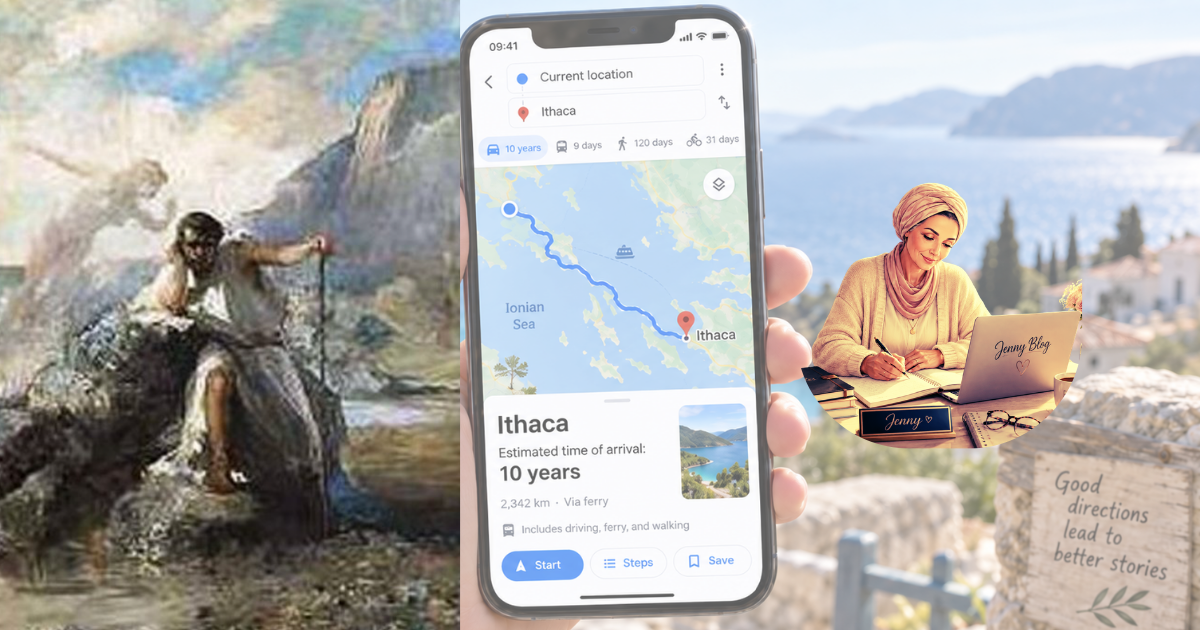
If Odysseus had Google Maps, the entire epic adventure might have fit into one short trip and ended before you could say “Cyclops.” Once the Trojan War was finally over, he could have sat down on the shore, pulled out his phone, and typed: Ithaca. And just like that, one of the greatest myths in history would have turned into an ordinary route, complete with warnings, shortcuts, and that cold voice, completely indifferent to human tragedy, saying: “Turn left.”
If Odysseus had owned a smartphone, not only Greece but all of Western literature might have been left without one of its greatest epics.
There would have been no ten-year journey home. No endless wandering across unknown seas. No mysterious islands.
We know that after ten years of war at Troy, Odysseus had a very simple plan: go home. Home was Ithaca. Penelope was there. His son Telemachus was there. His kingdom was there.
It should not have been complicated. The war had lasted ten years, and the journey home was supposed to be just that — a journey home.
But it wasn’t.
Because this was ancient Greece. Odysseus had the gods working against him, the Mediterranean was apparently full of monsters, strange forces kept interfering with traffic, and Google Maps did not yet exist.
And so Odysseus set out on what was probably the most complicated trip home in history. He sailed past dangerous islands, encountered the Cyclops Polyphemus, survived Circe, listened to the Sirens, lost ships and men, spent years stranded far from home, and repeatedly discovered that the phrase “we’ll be there soon” means absolutely nothing.
1. Modern Navigation Might Have Changed Everything
If Odysseus had carried an ordinary smartphone with Google Maps in his pocket, his epic journey home might not have lasted ten years or filled 24 books of Homer’s epic. It could have been reduced to one short, sweet notification on the screen:
“Fastest route to Ithaca: 4 days, with tolls and minor delays near Cyclops Island.”
Let’s imagine what the key points of Odysseus’s journey might have looked like if he had been able to press the “Calculate route” button.
Google Maps: Ithaca, 4 days, 6 hours and 42 minutes.
Odysseus: Excellent.
Google Maps: Traffic near Scylla. Faster route available.
Odysseus: Take it.
Google Maps: This route passes Charybdis.
Odysseus: Actually, don’t.
And imagine the Google reviews.
Cyclops Cave ★☆☆☆☆ (1.2)
“Beautiful scenery. Host unpleasant. Ate several members of our group. Would not recommend.”
The extra 0.2 stars are purely for the view.
Or the sorceress’s island:
★★★★★
“Excellent hospitality. Great food. Comfortable accommodations. Unfortunately, several guests were temporarily turned into pigs. Watch what you drink.”
Then there were the Sirens. Today, Google Maps would probably issue a warning:
“Danger ahead: extremely persuasive singing. Keep windows closed.”
Great advice for a car, but fairly useless on a wooden ship with no windows.
Odysseus, of course, would still insist on hearing them. He was intelligent, but also curious — and that is often the beginning of every good story and several very bad decisions.
The sailors would tie him to the mast and plug their ears. Odysseus would scream, “Turn! Turn left!” while Google Maps calmly replied:
“Continue straight for another 400 meters. Exit coming up.”
2. Maybe It Wouldn’t Have Changed Anything After All
Odysseus could have had satellite navigation, a weather forecast, storm radar, a power bank, and a fully charged phone, and the gods would still have found a way to ruin the trip.
First, a storm.
Google Maps: Recalculating route.
Another storm.
Google Maps: Recalculating route.
Ship destroyed.
Google Maps: Recalculating route.
Washed up on an unknown island.
Google Maps: GPS signal lost.
At some point, even Google would probably have given up.
Estimated arrival time in Ithaca: 10 years.
Then the optimistic option would appear:
Google Maps: Alternative route available. Fastest route: 3 days and 4 hours. Avoid islands with one-eyed shepherds.
Odysseus: Works for me.
And off he sails. Everything would be fine if not for one small detail: that bag of winds.
Odysseus is already close to Ithaca. He can see smoke rising from the shore. Home is practically in front of him.
Google Maps: In 5 km, turn right. You are approaching Ithaca. Estimated arrival time: 6:42 p.m.
Odysseus: Finally!
But the sailors think the bag contains gold. They open it, the winds burst out, and everyone is blown back across the sea.
Google Maps: Recalculating route…
A short silence.
Google Maps: Returning to starting point.
An even shorter silence.
Google Maps: New route: 10 years and 7 months. Would you like to avoid winds?
Odysseus: YES!
Google Maps: Option unavailable. Wind stronger than algorithm.
However you look at it, even Google Maps and a smartphone might not have helped Odysseus, because a few very practical problems remain.
Where would he charge the phone? At the Cyclops’s outlet? At the sorceress’s place? On a ship in the middle of the Aegean Sea? Even with a power bank, the battery would probably be down to 5 percent by the third day — and, according to every law of epic literature, that is exactly when another storm would arrive. And if the phone fell into the water, the last hope would go down with it.
Black screen. Dead GPS. Wet charger.
Odysseus would stare at the horizon.
And once again wander across the entire Mediterranean trying to reach Ithaca.
And What About Penelope?
Life in Ithaca would have been much easier for her. She would not spend the day weaving a shroud and the night undoing it in order to keep persistent suitors waiting for years. She would mute the “Suitors of Ithaca” group chat during the first week, block about a hundred men, and be left with just one problem: a notification on her phone.
“Your order (Odysseus) will arrive in approximately 20 minutes.”
And underneath:
“Driver delayed due to unforeseen circumstances.”
Penelope would simply look at the screen.
Of course he is.
She would also have the option “Track Odysseus live.”
A little blue dot would move across the Mediterranean. Then stop. Then head in completely the wrong direction. Then disappear. Then reappear seven years later on some lonely island.
Penelope: Odysseus, where are you?
Odysseus: Almost there.
Penelope would know very well what his “almost there” meant. So would every woman who has ever waited for someone who “just ran to the store.”
Eventually, the final notification would arrive:
“Odysseus will arrive in approximately 20 minutes. Prepare dinner and the dog Argos.”
And Penelope would, of course, rate the delivery:
★☆☆☆☆
“Ten years late. Still worth the wait.”
Odysseus might have lost his title as the greatest adventurer of antiquity, but he would have saved himself a great deal of stress — and generations of schoolchildren might have been spared one of the longest required readings in the history of education.
Literature teachers, on the other hand, would not be thrilled.
“Class, today we’re reading The Odyssey.”
“How many pages?”
“Three Google Maps screenshots.”
Because, let’s be honest, Homer would probably just press “Share location” today, and Penelope would receive:
“Location unavailable.”
So perhaps Homer would not have been left without material after all.
But here is the interesting part.
If Odysseus had returned home by the shortest route, would anyone remember him today?
The Odyssey is not really a story about geography. It is a story about everything that happens when the route refuses to cooperate. Odysseus returns home older, changed, and burdened by the consequences of his own decisions and mistakes. The journey matters precisely because it was not easy.
Google Maps is wonderful because it helps us avoid getting lost.
But sometimes the story begins only when we do.
Odysseus lost roughly ten years and became one of the most famous travelers in literature. We get an extra seven minutes added to our route and start questioning the entire system.
There would have been no ten-year journey home. No endless wandering across unknown seas. No mysterious islands.
If Odysseus had owned a smartphone, not only Greece but Western literature as a whole might have been left without one of its greatest epics.
And What Can We Say Instead of a Conclusion?
Homer might have written only The Iliad, while The Odyssey might never have existed. That would mean literature losing another epic of no fewer than 12,109 lines — no ten years of wandering, no Cyclops, Sirens, Circe, Scylla, or Charybdis, at least not in the way we remember them today through Odysseus’s journey.
Generations of students would never have had to follow Odysseus across the Mediterranean, literature teachers would have lost dozens of lessons, and modern culture would have been deprived of countless books, films, songs, video games, and memes that have returned to this story for centuries.
And perhaps Christopher Nolan wouldn’t be making millions from Odysseus today.
One smartphone might not have erased Homer, but it probably would have shortened his bibliography by 12,109 lines.
And perhaps it is a good thing that Google Maps never made it to ancient Greece.
Because sometimes the greatest stories happen precisely because someone failed to find the shortest way home.
By Jenny