


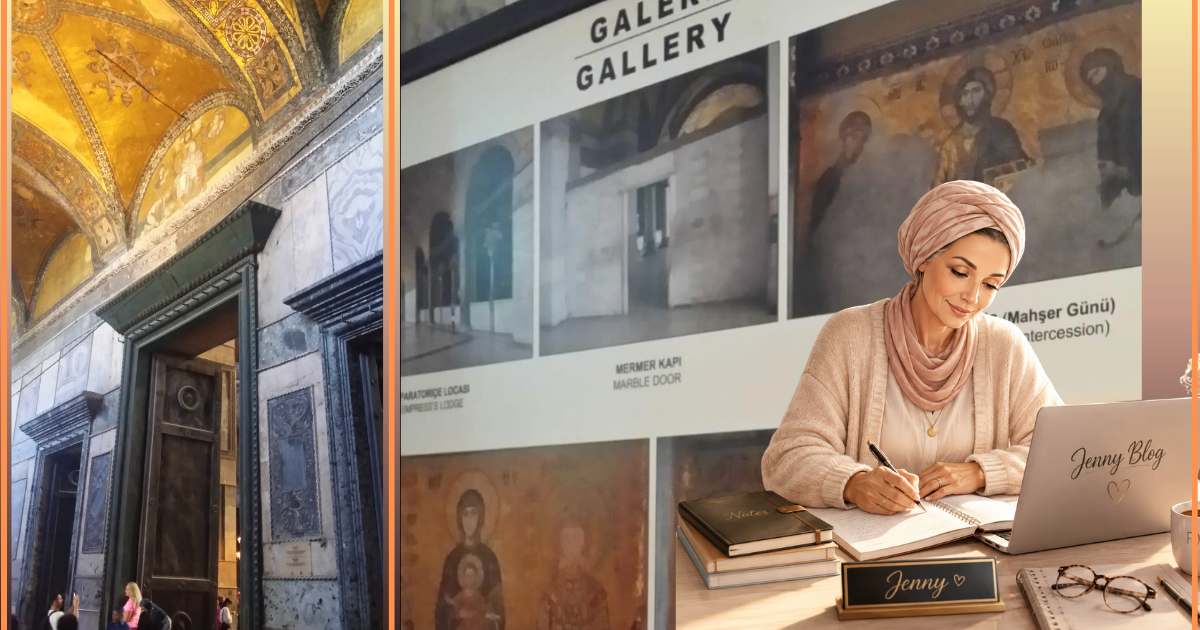
Today, few people remember the three empresses who ruled one of the most powerful empires of their time. Topics change from minute to minute. Our attention spans are shorter than ever. But I will remind you.
Across nearly four centuries, three women — Theodora, Irene, and Zoe — ruled Byzantium. They did not live at the same time. They did not follow the same paths to power. Nor did they leave the same mark. But each, in her own way, pushed the political, religious, and social boundaries of the world she lived in. Some of their decisions still have consequences today.
And all of this was happening in the East.
While what we now call the West was only beginning to take shape, while the edges of the map were still populated by “wild tribes” barely mentioned in the civilized world, three empresses were ruling in the East.
Western civilization as we know it did not yet exist. There was the East.
And here, Native American peoples already had their own communities, languages, beliefs, trade, wars, and alliances. They knew the name of every river and every wind. They had all of that long before Europe decided to place their lands on its maps.
The story of Theodora, Irene, and Zoe is as old as the two Americas.
What Does the Word “Civilization” Actually Mean?
The word “civilization” is almost Machiavellian.
Throughout history, civilization was rarely measured by peace.
It was rarely measured by humanity’s ability to live in harmony with nature.
It was measured by power.
Civilization belonged to those who conquered, expanded borders, built empires, and left monumental structures behind.
Those were the people who entered the great history books.
Those who did not were treated as if they had never existed in the story of civilization.
And that is why, when we stand today before the magnificent buildings we admire, perhaps we should not admire them entirely without reservation.
Not because they are not beautiful — they are.
But because beauty often hides its price.
Behind those walls were wars, conquests, taxes, forced labor, and poverty.
Behind every arch, every dome, every stone were someone’s back, someone’s exhaustion, someone’s life.
Especially in times when there were no machines — when every block had to be carved, carried, and lifted by human hands.
The monumental beauty of empires was rarely paid for out of the wealth of emperors.
It was paid for by people who barely had enough to survive.
And Today?
Today, almost no one cares what happened long ago.
Algorithms are conquering the world.
Artificial intelligence writes, calculates, draws, talks to people, and is already competing with us in jobs we believed, until yesterday, belonged only to humans.
Power has moved from blocks of stone to servers, from empires to data centers, from military campaigns to digital models that learn faster than we can understand what is actually happening.
Civilization was once measured in territory.
Today it is measured in processing cycles.
Who still cares about empresses who lived a thousand years ago?
I do.
Because old stories have one inconvenient habit: they often stop being old the moment you read them closely enough.
Three Women Who Changed the World
Across several centuries, three empresses passed through this world: Irene, Theodora, and Zoe.
Three completely different stories.
Three women who, each in her own way, influenced politics, religion, and the course of history.
Purely female.
They were women who changed the world.
I would not want you to think I am a walking archive.
But I have read. I have traveled. And I often return to those distant times and to phenomena that are, strangely enough, both completely different from and painfully similar to what we see today.
I stood in those places. I listened to guides. I entered old churches, palaces, and museums. I heard stories that, with very little effort, could be placed directly into the world we live in now.
And one more thing…
I have already left, even though I have not moved from where I am.
Sometimes you do not need to physically move in order to no longer be here.
I am there, actually.
Somewhere among those walls, corridors, mosaics, and the stories of people who lived centuries before us.
I stood in front of the black marble in Hagia Sophia.
For centuries, emperors and empresses left their marks on it.
Beneath those marks, traces of ancient Greek motifs can still be seen — because once, this was also a pagan temple.
Hagia Sophia — A Story of Its Own
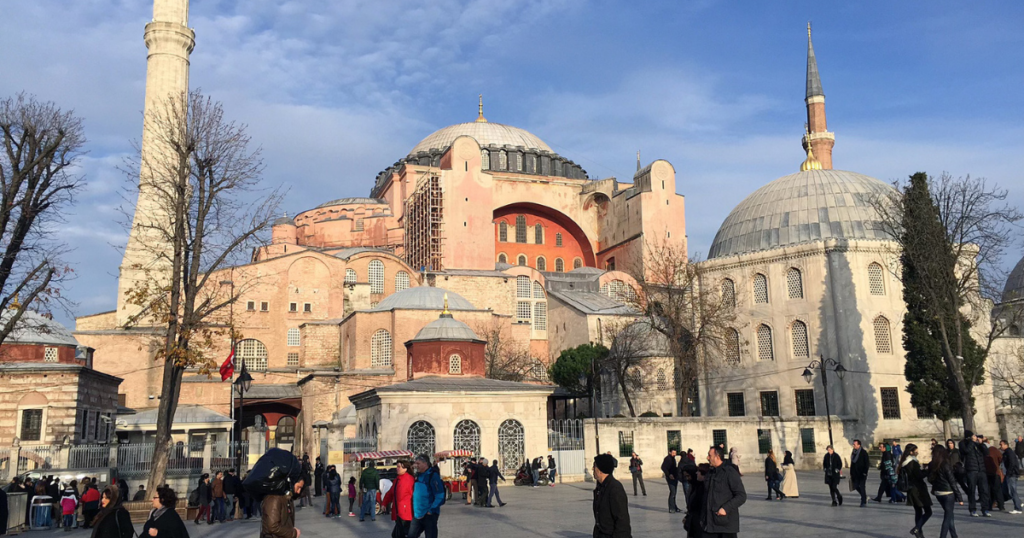
For a thousand years, the largest church in the world. For five hundred years, a mosque. For forty-two years, a cathedral. Then a museum.
To truly see it, you would need days.
To describe it, you would need One Thousand and One Nights.
It was built three times. It burned. It collapsed.
It shifted from east toward southeast because of earthquakes — almost as if, at the very moment its new purpose required it, the building itself had turned.
Its walls still carry all of those transformations, from the world of ancient Greece to the present day.
Inside are doors that, according to legend, can never be opened, and doors that can never be closed. Some are said to have been made from the wood of Noah’s Ark.
There are also the Imperial Doors, through which only emperors were allowed to pass. Other doors were reserved for the clergy.
There were no doors for ordinary people.
This was a church of nobility and clergy.
Near the entrance stands the Wishing Column — a stone touched by those carrying wishes they do not dare say aloud.
Before passing through the Imperial Doors, continue down the corridor. You will reach the mosaics of the Byzantine empresses.
Do not go without a guide.
They know the juicy details of imperial life that never make it into textbooks.
Zoe — The First Influencer
In the lower right corner, you will find Zoe’s mosaic.
Why Zoe?
Because her reign was full of struggles for the throne, turbulence, and controversy.
And because she introduced what could be called one of the earliest known photomontages in history.
The first “Photoshop.”
Zoe Porphyrogenita, who lived in the 11th century, was an empress who changed emperors.
Some even say she killed them.
While her first husband was still alive, she commissioned a gilded mosaic: she and her husband seated on either side of Christ.
After his death and her remarriage, she did not commission a new mosaic.
She simply replaced the head of the first husband with the head of the second.
And then the third.
She did not change her own face.
But she did edit it.
They say that the last time she stood before the mosaic, at the age of 64, after marrying for the third time, she asked to be portrayed younger, tighter, more youthful — the way she saw herself from within.
In an age without social media, she already understood the power of the image.
In an age without filters and silicone, she was literally rewriting the past.
And announcing the future.
As if she already knew:
Women would not only change pictures.
They would begin changing themselves.
Theodora — From Entertainer to Empress
And then comes Theodora.
Chronologically, she ruled before Irene and Zoe.
A woman who was not born in a palace and did not belong to the world from which empresses were usually chosen.
She was an entertainer and an actress.
Some sources went much further and described her as a prostitute. The most scandalous stories about her youth were written by Procopius, who was deeply hostile toward her, so historians today read those accounts with caution.
Women like her did not belong to respectable society.
Their social position was at the very bottom.
The doors of respectable society — and even of religious life — were almost closed to them.
And here lies one of the great paradoxes of her story.
A woman who came from a world considered unworthy by the society of her time became an empress.
And during the reign of Theodora and Justinian, Hagia Sophia was built — the largest and most monumental church of its age.
A woman for whom the doors of the church had almost been closed
helped build the largest church in the world.
From a woman barely considered worthy of crossing a church threshold —
to an empress whose name would forever be connected to one of the most famous buildings in human history.
But Theodora was not simply a woman with an unusual biography.
Theodora is older than both Americas as we know them today.
And she knew exactly what she wanted.
The Nika Revolt — The Moment Theodora Refused to Run
In the year 532, during the Nika Revolt, Constantinople was burning.
The rebels had proclaimed another emperor. Justinian and his men were seriously considering escape.
There was money.
The sea was there.
The ships were ready.
And then Theodora stood up.
According to Procopius, what she essentially told them was:
If you want to run — you can.
We have money.
We have the sea.
We have ships.
I am not going.
She said she never wanted to live to see the day when people would no longer call her empress.
She invoked an old saying:
Imperial purple makes a fine burial shroud.
In other words: she would rather die as an empress than live as a fugitive without a crown.
Justinian stayed.
The revolt was then crushed in blood.
Imperial forces entered the Hippodrome.
Procopius gives a figure of around 30,000 dead.
For one moment, Theodora may have saved Justinian’s throne.
But the decision to stay also ended in a terrible massacre.
There is no simple heroine here.
And perhaps that is exactly what makes her so fascinating.
Of course, entertainers today have not exactly been left without crowns either.
We have pop queens and rock queens.
They do not rule territories, but they rule our attention.
They have millions of subjects — we simply call them followers now — who watch them, listen to them, and follow them.
Today, they are allowed to enter churches.
They probably just do not prefer that particular sport.
Theodora went a little further.
She rose from the world of entertainment to the place where the fate of an emperor — whether he would flee or stay and fight — was decided.
Irene — 8th Century
The second of them was Irene, a Greek woman from Athens.
She ruled in an age dominated by giants: Charlemagne and Harun al-Rashid.
Irene and the Icons
While men conquered with swords, Irene changed the walls of churches.
Iconoclasm was a period in which icons were banned and images of Christ were removed and scraped from church walls, and it lasted for almost a century.
But Irene loved icons, at first secretly.
According to tradition, she even risked her marriage because of them: her husband discovered an icon she had been hiding, and not long afterward, he died suddenly.
Irene and Power
Alongside icons, Irene also loved power.
When her son Constantine VI came of age and tried to take control of the throne, Irene had no intention of simply stepping aside.
She sent away his fiancée, the daughter of Charlemagne, destroying an important political alliance.
And then she ordered that her own son be blinded in the same palace where she had given birth to him.
Not out of hatred.
But because she loved power.
And power is not shared.
Power is held.
She became the first woman in Byzantine history to rule in her own name — not as an emperor’s wife, not as a regent, not as a shadow beside the throne.
In some documents, she even used the title basileus — emperor, not empress.
Irene, Charlemagne, and the Birth of the Political West
Far away, in Rome — a city that was no longer the capital of anything except memories — Pope Leo III looked toward the East and saw an opportunity.
Because if a woman was sitting on the imperial throne in Constantinople, then, according to the logic of the time, the throne was vacant.
The Roman Empire — the real one — had no emperor.
And so, on Christmas Day in the year 800, in St. Peter’s Basilica, while the Frankish king Charlemagne bowed in prayer, the pope placed a crown on his head and proclaimed him Roman emperor.
Charlemagne, they say, was surprised.
Or at least that is what the chronicles later claimed.
It is difficult to know whether the surprise was genuine or part of the performance, because even surprise can become a political weapon when someone later asks who actually proposed the crown in the first place.
But the essence remained the same:
That day, the West was born as a political idea.
Not as geography — geography had existed for a long time.
But as a claim.
A claim that a Roman Empire could also exist in the West, separate from the one in Constantinople, and that this separation was legitimate precisely because a woman ruled in the East.
When Irene heard the news, she reportedly considered marrying Charlemagne — joining the two empires into one through her own body, as power had so often been joined through marriage.
It was not meant to happen.
Two years later she was overthrown, exiled to an island, and died far from the throne she had loved more than her son’s eyes.
And What Was I Trying to Say?
Perhaps nothing extraordinary.
Only that history is not nearly as dead as we think.
Clothes change.
Titles change.
Borders change.
Languages and tools change.
Emperors become presidents, subjects become followers, mosaics become Photoshop, and empires move from palaces into servers and data centers.
But some things remain astonishingly similar.
The desire for power.
The need to leave behind an image of ourselves.
The struggle to decide who gets to speak, who gets to believe, who gets to rule, and whose name will remain after everyone else disappears.
Theodora, Irene, and Zoe were not the same kind of women.
They were neither saints nor simple heroines.
One rose from the world of entertainment to the imperial throne.
Another blinded her own son for power, yet restored icons to the walls of churches.
The third changed emperors — and their heads on a mosaic.
And all three left a mark.
Perhaps that is the whole point.
While we rush toward everything we call new, very often we are simply repeating what is old — only with better technology.
And while we like to believe that we invented influence, propaganda, image manipulation, the battle for attention, and political power, somewhere on the walls of Hagia Sophia stands a mosaic almost a thousand years old, quietly telling us:
You did not invent all of this.
That is why it is worth going back sometimes.
Not so we can live in the past.
But so we can understand the present a little better.
by Jenny