


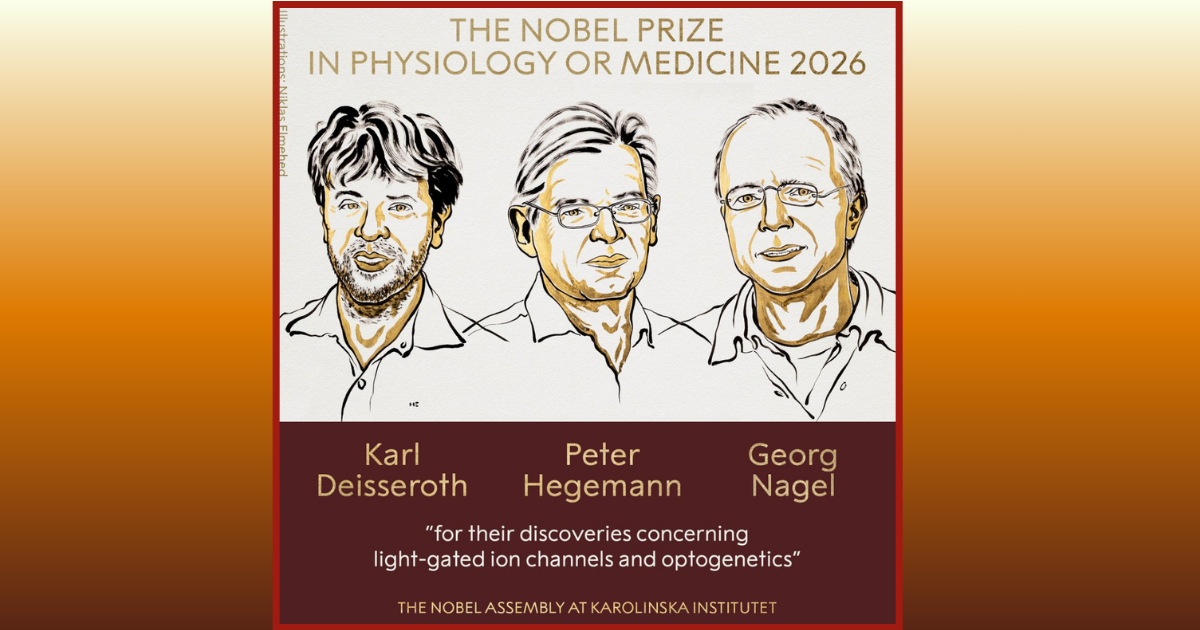
STOCKHOLM — The 2026 Nobel Prize in Physiology or Medicine has been awarded to Karl Deisseroth, Peter Hegemann and Georg Nagel for discoveries that led to the development of optogenetics, a revolutionary method that allows scientists to control the activity of individual nerve cells using light.
The Nobel Committee announced the award Monday, recognizing work that transformed modern neuroscience and gave researchers a powerful new way to study how the brain creates memories, emotions and behavior.
Optogenetics works by introducing light-sensitive proteins into selected neurons. Researchers can then use pulses of light to switch those cells on or off with remarkable precision. This makes it possible to study the role of specific brain circuits in ways that were previously impossible.
The discoveries behind the technique developed over several stages. Hegemann and Nagel helped identify and characterize light-sensitive proteins known as channelrhodopsins, while Deisseroth later demonstrated how these proteins could be used to control neurons in living systems.
The result was a new research tool that has since spread to laboratories around the world.
Optogenetics is now widely used to investigate fundamental questions about the brain, including how memories are formed, how emotions are regulated and how different neural circuits influence behavior. Researchers are also using the method to better understand neurological and psychiatric disorders.
The Nobel Prize announcement described the ability to activate or silence individual nerve cells in a living brain as a major step toward unraveling some of neuroscience’s most difficult mysteries.
The three laureates will share the prize money of 12 million Swedish kronor, worth roughly $1.2 million.
Their work represents one of the most influential advances in modern brain research, giving scientists unprecedented control over neural activity and opening new paths for understanding how the brain works.
Sources: The Nobel Prize, Reuters
By NJ RADAR Team