


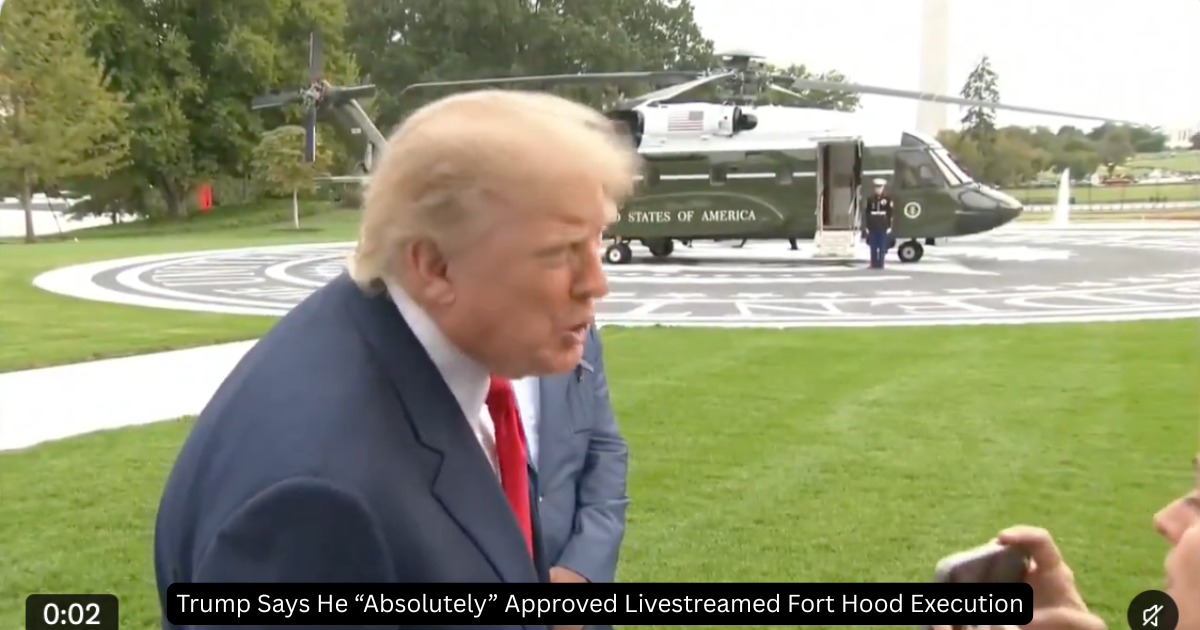
The president confirmed his approval when directly questioned by reporters, but also suggested that a final decision about broadcasting the execution could still be made. The controversial plan has drawn criticism from both Republicans and Democrats, as well as the United Nations.
WASHINGTON, October 9, 2026 — President Donald Trump said Friday that he had personally approved the planned livestreamed execution of Nidal Malik Hasan, the former U.S. Army major convicted of killing 13 people and wounding 32 others at Fort Hood, Texas, in 2009.
Trump had already authorized Hasan’s execution by firing squad, scheduled for December 3. However, Friday’s exchange with reporters addressed a separate and increasingly controversial issue: whether the execution should be broadcast live for the public to watch.
A reporter directly asked the president:
“Did you personally authorize or approve the livestreamed execution?”
Trump responded:
“Did I approve? Absolutely I did.”
The exchange was captured on video and reported by Mediaite.
Trump Also Leaves Open the Possibility of Reconsidering
Despite his unequivocal answer, Trump made another comment during the same encounter that introduced uncertainty about whether the livestream would ultimately take place.
Asked earlier about the broadcast, he said he would make a determination about it while reaffirming that Hasan would be executed.
The two statements leave an unresolved question: has Trump given final authorization for the livestream, or could the White House still reconsider the public broadcast?
Pentagon Plans a Public Execution
Defense Secretary Pete Hegseth announced Thursday that Hasan’s execution would be carried out by a military firing squad at Fort Hood on December 3, 2026, at 1 p.m. Central Time.
The Pentagon subsequently confirmed plans to livestream the execution.
Hegseth defended the decision, arguing that the public should understand the serious consequences of Hasan’s crimes.
Hasan, a former Army psychiatrist, was sentenced to death in 2013 after a military court convicted him of the mass shooting at the Texas military installation on November 5, 2009.
The planned execution would be the first carried out by the U.S. military since 1961 and the first military firing squad execution since 1945.
Criticism From Both Political Parties
The proposed livestream has generated opposition from lawmakers across the political spectrum.
Republican Senator Thom Tillis condemned the idea of a public execution, comparing the practice to those associated with authoritarian governments.
Republican Congressman Austin Scott also criticized broadcasting the execution while expressing support for Hasan’s death sentence.
Democratic Senator Jack Reed called for the administration to reconsider, warning that broadcasting an execution could undermine American values and damage the country’s international reputation.
Vice President JD Vance said Friday that he was uncertain whether the execution would actually be livestreamed and stated that he would not watch it.
United Nations Raises Human Rights Concerns
The United Nations has strongly criticized the proposed broadcast.
UN human rights officials warned that livestreaming an execution could amount to a public execution and violate international prohibitions against torture and cruel treatment.
The controversy has raised broader questions about the distinction between carrying out a legally imposed death sentence and turning that punishment into a public event.
A Decision That Could Set a Historic Precedent
Public executions largely disappeared from American practice during the twentieth century, and modern executions generally take place under strictly controlled conditions with limited witnesses.
A government-organized livestream would represent a significant departure from those practices.
Although Trump said he had approved the livestream, his suggestion that another determination could still be made means the final broadcasting arrangements remain uncertain.
For now, Hasan’s execution remains scheduled for December 3, while the debate over whether the American public should be allowed to watch continues.
By NJ RADAR Team