


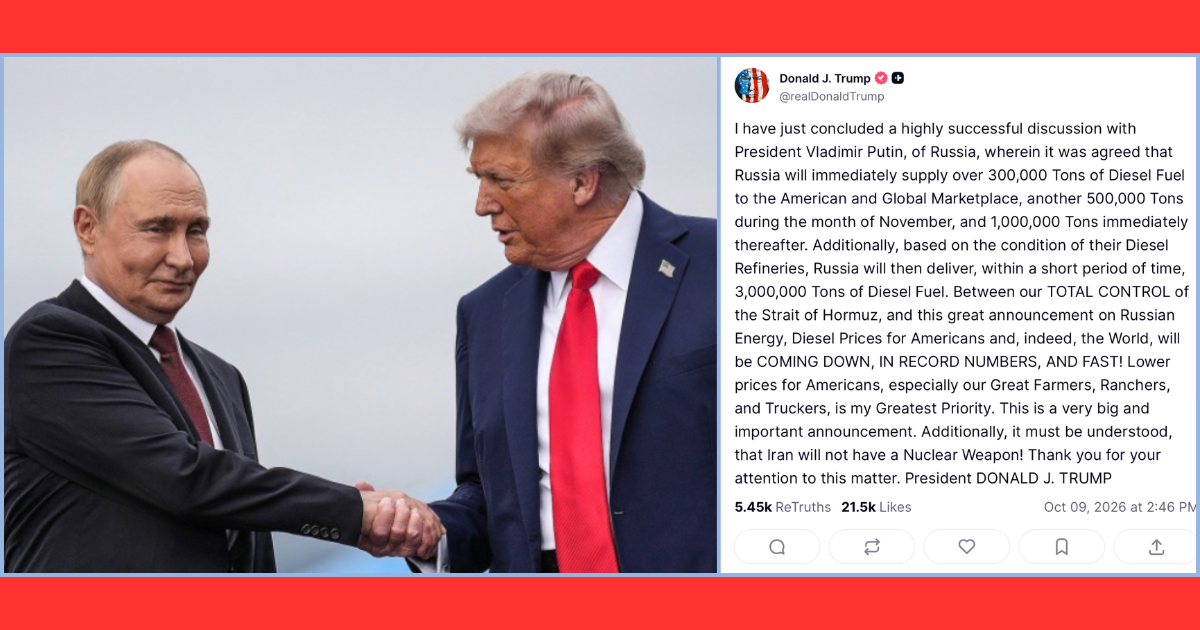
Russia has faced fuel shortages and refinery disruptions, while Washington has spent years restricting Russian energy trade. The unexpected agreement raises questions about whether the promised fuel will arrive — and what Moscow receives in return.
WASHINGTON, October 9, 2026 — President Donald Trump announced Friday that he had reached what he described as a highly successful agreement with Russian President Vladimir Putin to release millions of tons of Russian diesel fuel to American and global markets.
The announcement comes at a particularly unusual moment. Russia remains under American sanctions over its war in Ukraine, while its own diesel industry has struggled with refinery damage, production disruptions, and domestic supply pressures.
Trump said Russia would immediately make more than 300,000 tons of diesel available, followed by another 500,000 tons in November and one million tons afterward. An additional three million tons would depend on the condition of Russian refineries.
The total announced volume could reach approximately 4.8 million tons.
However, announcing an agreement is not the same as completing deliveries.
Can Russia Deliver What It Has Promised?
One of the biggest questions is whether Russia can supply the promised quantities on the announced schedule.
Ukraine’s attacks on Russian energy infrastructure have damaged refining capacity, while Moscow has faced domestic fuel shortages and imposed export restrictions to protect its own market.
These difficulties make the delivery schedule particularly significant.
Trump himself acknowledged that the additional three million tons would depend on the condition of Russian diesel refineries.
Although Russia is one of the world’s major oil producers, crude oil production and the ability to refine, transport, and export diesel are different matters.
There is currently no public confirmation that the full 4.8 million tons have been secured for delivery, nor that all shipments will arrive within the suggested timeframe.
Why Is Washington Making a Deal With a Sanctioned Country?
The agreement also represents a striking change in American policy toward Moscow.
Since Russia’s invasion of Ukraine in 2022, Washington has used energy sanctions to restrict Russian revenue and increase economic pressure on the Kremlin.
Yet the Trump administration is now temporarily easing restrictions on Russian diesel trading in an attempt to reduce fuel prices.
The US Treasury Department has authorized certain transactions involving Russian diesel, with the temporary relief expected to remain in place until April 2027.
The decision raises a difficult question: can Washington simultaneously maintain economic pressure on Russia over Ukraine while facilitating renewed Russian energy sales?
What Does Putin Get in Return?
Perhaps the most politically sensitive question is what Russia receives from the agreement.
The immediate benefit is clear: easing restrictions on Russian diesel allows Moscow greater access to international energy markets and potentially additional export revenue.
That could provide economic relief to a country facing substantial financial pressure from sanctions and the continuing war.
However, the full terms of Trump’s conversation with Putin have not been publicly disclosed.
There is no verified evidence that Washington offered additional concessions concerning Ukraine, territorial issues, or other sanctions in exchange for the diesel agreement.
Still, the lack of publicly available details leaves an important question unanswered: was the temporary relaxation of energy restrictions the entire arrangement, or were other matters discussed?
Will the Deal Actually Lower American Fuel Prices?
The administration argues that additional diesel supplies could relieve pressure on transportation, agriculture, and consumer prices.
Diesel is essential to trucking, farming, manufacturing, and moving goods throughout the United States.
But energy analysts have questioned whether the initial supplies are large enough to make a significant difference.
Even if Russia delivers the promised quantities, the impact will depend on global fuel demand, transportation logistics, refinery output, and the timing of shipments.
A political announcement alone cannot guarantee lower prices at American fuel pumps.
Ukraine Warns Against Rewarding Moscow
Ukrainian President Volodymyr Zelenskyy has criticized the arrangement, arguing that loosening restrictions on Russian energy sales risks strengthening Moscow economically while the war continues.
The timing is especially sensitive because American, Ukrainian, and European representatives are engaged in diplomatic efforts aimed at ending the conflict.
Renewed Russian diesel trade introduces another complicated issue into those negotiations.
An Agreement With More Questions Than Answers
For now, the most significant part of the Trump-Putin announcement may not be the volume of diesel promised, but the unresolved questions surrounding it.
Can Russia deliver millions of tons while dealing with domestic shortages and damaged refineries?
Will American consumers actually see lower fuel prices?
How will Washington reconcile the deal with its sanctions policy?
And, most importantly, what exactly was agreed between Trump and Putin beyond the publicly announced fuel shipments?
Until delivery records, commercial arrangements, and the full scope of the agreement become clearer, the announcement remains a major diplomatic and economic development — but not proof that the promised fuel will reach its destination.
Kremlin Reveals Broader Talks on Ukraine and Intelligence Cooperation
The Kremlin’s account of the Trump-Putin phone call suggests that the discussion went considerably beyond diesel supplies.
According to the Russian government, the two presidents devoted significant attention to prospects for resolving the war in Ukraine and also discussed Iran and broader bilateral relations.
Moscow further stated that the leaders agreed to maintain personal contacts and continue cooperation between their presidential administrations, intelligence services, and other government agencies.
While no specific agreement on Ukraine was announced, the Kremlin’s statement raises additional questions about the broader diplomatic context of the energy deal.
It remains unclear whether any concessions beyond the publicly announced sanctions relief were discussed or agreed upon.
Sources: Reuters | Associated Press | US Treasury
By NJ RADAR Team