


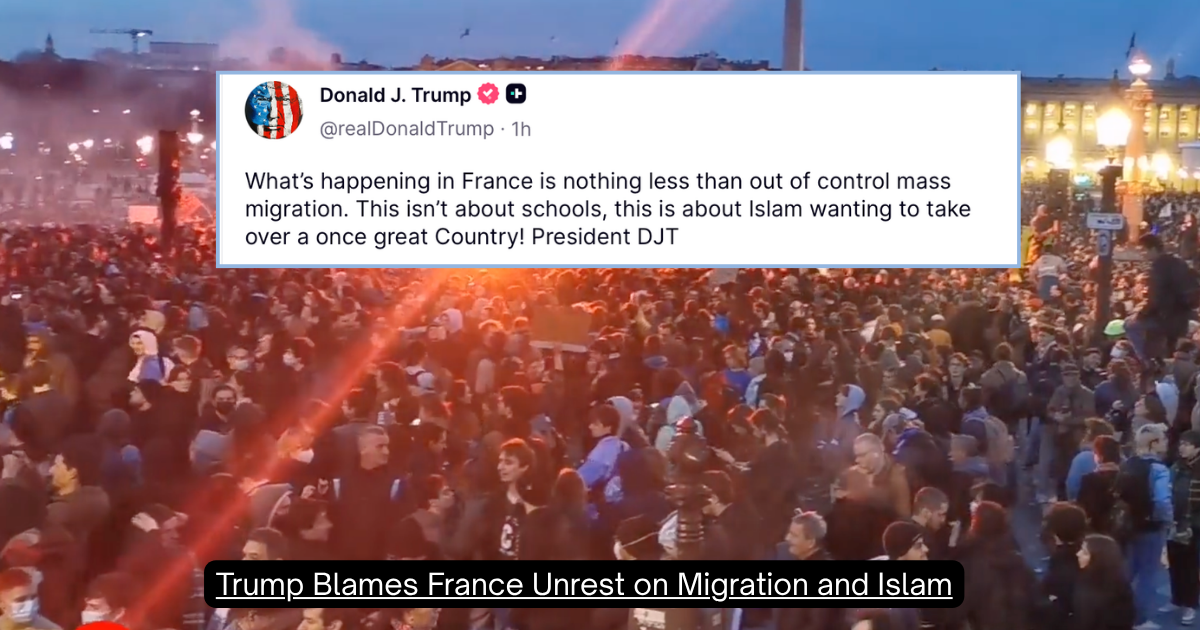
President Donald Trump weighed into France’s escalating unrest on Tuesday, arguing that the demonstrations spreading across the country are not fundamentally about education but about mass migration and Islam.
In a post on Truth Social, Trump wrote:
“What’s happening in France is nothing less than out of control mass migration. This isn’t about schools, this is about Islam wanting to take over a once great Country!”
His intervention adds a new political dimension to demonstrations that have already developed into one of France’s most serious youth-led protest movements in decades.
What actually triggered the protests?
The available evidence, however, does not support the idea that the movement began as a protest connected to Islam or immigration.
The demonstrations started in disadvantaged areas around Paris and were initially organized by high school students frustrated by conditions inside the French education system.
Students have complained about teacher shortages, overcrowded classrooms, deteriorating school buildings and insufficient resources. The protests quickly spread to hundreds of schools across France, with teachers, parents and unions later joining some demonstrations.
Reuters reported that students have demanded the replacement of absent teachers, improvements to aging school facilities and changes to school schedules. France’s government has itself acknowledged those concerns, with Prime Minister Sébastien Lecornu ordering ministers to prepare proposals addressing student demands.
On Tuesday, more than 250,000 people took part in demonstrations across France, according to official figures reported by AP.
From school protests to a public-order crisis
What began as a campaign over education has nevertheless changed significantly as it has grown.
Some demonstrations have descended into serious clashes with police. Protesters have thrown projectiles and set fires in several cities, while riot police have responded with tear gas and other crowd-control measures.
Thousands of people, many of them minors, have been arrested since the protests began. Hundreds of protesters and police officers have also been injured.
That escalation helps explain why events in France are now being discussed far beyond the original dispute over school funding.
But escalation does not necessarily establish a different cause.
There is an important distinction between asking why the demonstrations originally began and asking why unrest later became violent or politically charged.
Trump offers a much broader interpretation
Trump is making the second argument.
Rather than focusing on the students’ stated demands, he is interpreting the scenes in France through a much broader debate over immigration, integration and the future of European societies.
Those questions are real political issues in France and have played a major role in French elections and public debate for years.
But based on current reporting, there is no evidence establishing that Islam or Muslim immigration organized or caused this particular protest movement.
The documented starting point remains dissatisfaction with schools.
That makes Trump’s statement significant not because it settles the question of what is happening in France, but because it shows how rapidly a domestic protest can become part of a much larger international political argument.
The same images can now be interpreted in two very different ways: French students and unions describe a crisis in public education, while Trump presents the unrest as evidence of a wider migration and cultural crisis in Europe.
For readers, those two claims should not be confused.
One describes the demonstrators’ documented grievances.
The other is the American president’s political interpretation of what those events ultimately represent.
Sources: Reuters; Associated Press (AP); Donald J. Trump / Truth Social.
By NJ RADAR Team
Editor’s Note: NJ Radar reports on these protests for informational purposes. The views and slogans shown or described do not necessarily reflect the views of the publication.