


Neutrinos can reveal hidden regions of the universe that traditional telescopes cannot see, helping scientists study black holes, exploding stars and other extreme cosmic events.
Because neutrinos can travel through matter almost without being stopped, they can carry information from places that light cannot easily escape. Francis Halzen’s work with the IceCube Neutrino Observatory helped turn these elusive particles into a powerful new tool for exploring the universe.
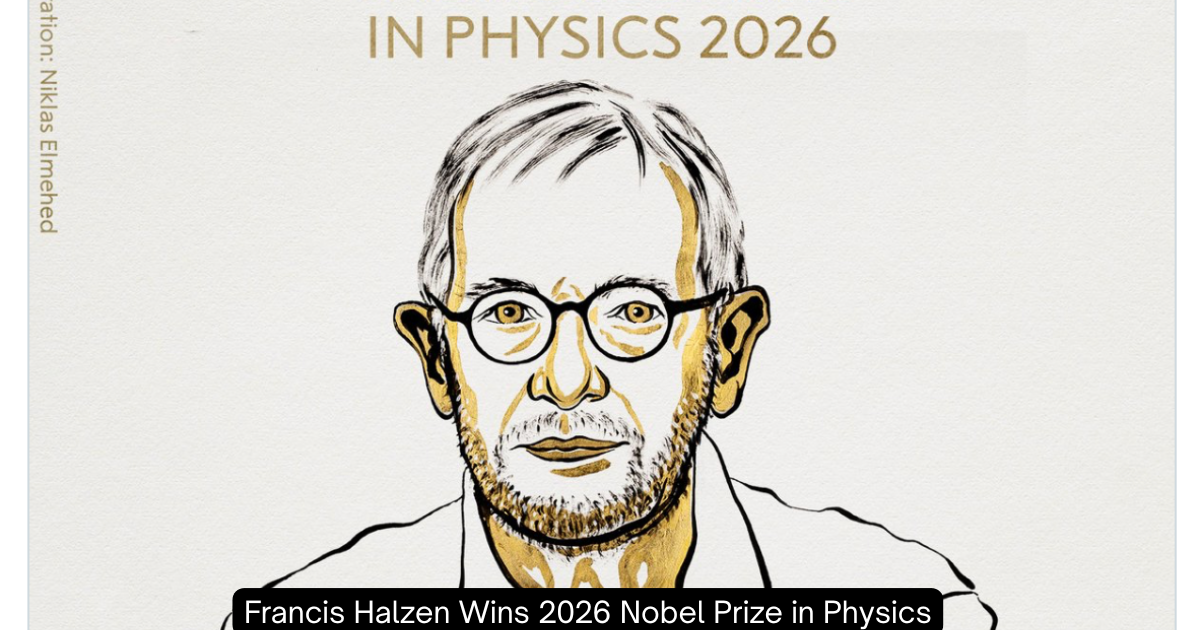
Belgian-American physicist Francis Halzen has won the 2026 Nobel Prize in Physics for pioneering work that opened a new way of observing the cosmos.
The Royal Swedish Academy of Sciences announced Tuesday that Halzen, 82, will receive the prize “for decisive contributions to the IceCube Neutrino Observatory and the discovery of high-energy neutrinos of astrophysical origin.”
Looking at the Universe Through “Ghost Particles”
At the center of Halzen’s work are neutrinos, tiny electrically neutral particles that can travel enormous distances through space and pass through planets, buildings and even the human body almost without interacting with anything.
Because they are so difficult to detect, neutrinos are sometimes called “ghost particles.”
But that same property makes them extraordinarily useful to astronomers. Unlike light or charged particles, neutrinos can escape from extremely violent regions of the universe and travel almost unchanged to Earth. Their direction can point scientists back toward the cosmic events that produced them.
They can carry information from some of the universe’s most energetic environments, including exploding stars, gamma-ray bursts and processes involving black holes and neutron stars.
A Telescope Hidden Deep Beneath Antarctic Ice
Halzen realized decades ago that the exceptionally clear ice beneath the South Pole could be transformed into an enormous particle detector.
That vision eventually became the IceCube Neutrino Observatory.
Instead of using a traditional telescope with mirrors or lenses, IceCube uses more than 5,000 light sensors embedded within roughly one cubic kilometer of Antarctic ice, extending as deep as about 2,500 meters below the surface near the Amundsen-Scott South Pole Station.
Most neutrinos pass straight through Earth without leaving any sign.
Very occasionally, however, one interacts with matter in the Antarctic ice. That collision creates secondary particles that produce extremely faint flashes of light. IceCube’s sensors detect those flashes, allowing scientists to reconstruct the neutrino’s energy and direction.
An Idea Many Scientists Were Not Sure Would Work
Halzen first proposed using Antarctic ice to search for high-energy neutrinos in 1988.
Turning the idea into reality required decades of scientific and engineering work. IceCube was eventually completed in 2011.
Halzen acknowledged after receiving the Nobel Prize that the project was far from guaranteed to succeed.
He said that when the project began, even many of those involved were uncertain whether such an ambitious detector could actually work.
The Nobel Committee credited his scientific vision and leadership with making the observatory possible and helping establish an entirely new form of astronomy.
IceCube Found Neutrinos Coming From Deep Space
IceCube eventually detected extremely energetic neutrinos that could not be explained simply by processes occurring in Earth’s atmosphere.
Researchers established that some originated within the Milky Way and others from far beyond our galaxy.
That discovery gave astronomers a new messenger from the cosmos.
Instead of studying the universe only through visible light, radio waves, X-rays or gamma rays, scientists can now use neutrinos to investigate places and events that may otherwise remain hidden.
A New Kind of Astronomy
The significance of IceCube goes beyond the detection of individual particles.
Neutrino astronomy can be combined with observations from conventional telescopes and gravitational-wave detectors, giving scientists different ways to observe the same cosmic event.
This approach, often known as multi-messenger astronomy, can help researchers investigate how nature accelerates particles to extraordinary energies and what happens around some of the most extreme objects in the universe.
Halzen said the field may still be at its beginning.
“The real excitement is that I cannot answer that question yet,” he said when asked what IceCube might ultimately reveal. “This is just an introduction to the science, the astronomy is still to come.”
From Belgium to Wisconsin and the South Pole
Halzen was born in Belgium and is a professor at the University of Wisconsin–Madison, where he has spent much of his career studying particle physics and astrophysics.
His work eventually brought together an international collaboration of scientists and engineers operating one of the world’s most unusual observatories in one of its harshest environments.
During the Antarctic winter, temperatures can fall below minus 50 degrees Celsius, leaving a small crew responsible for maintaining the observatory while aircraft cannot routinely reach the station.
Nobel Prize Comes With $1.2 Million Award
Halzen will receive 12 million Swedish kronor, approximately $1.2 million, along with the Nobel medal and diploma.
The award ceremony will take place in Stockholm on December 10, the anniversary of Alfred Nobel’s death.
For Halzen, however, the biggest legacy may be IceCube itself: a telescope without a conventional lens, buried beneath Antarctic ice, using particles that are almost impossible to detect to reveal parts of the universe scientists could not previously see.
Sources: Royal Swedish Academy of Sciences, Nobel Prize, Reuters
By Aziza Smailovic