


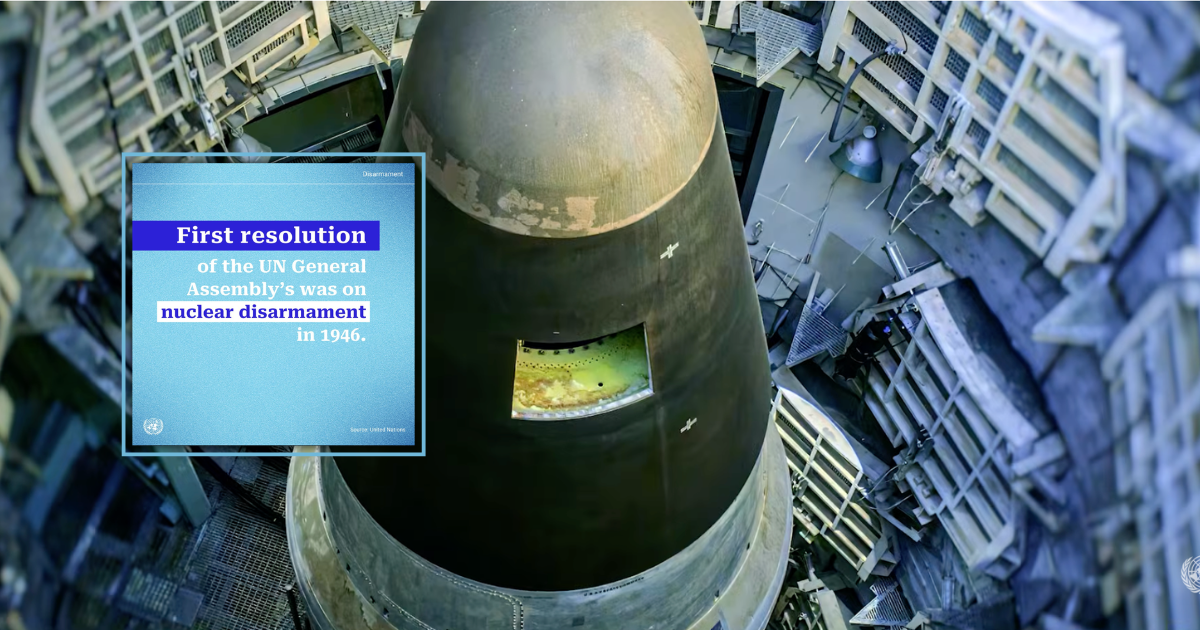
The United Nations is marking the International Day for the Total Elimination of Nuclear Weapons on September 26, renewing its call for a world free of nuclear weapons at a time of rising geopolitical tensions and renewed concern over nuclear risks.
The observance is not new. Nuclear disarmament has been one of the United Nations’ core objectives since its earliest days. In fact, the very first resolution adopted by the UN General Assembly in 1946 created the Atomic Energy Commission and called for proposals to eliminate atomic weapons and other major weapons of mass destruction.
The modern International Day was established through General Assembly resolutions beginning with Resolution 68/32 in 2013, with September 26 designated as an annual opportunity to raise awareness about the threat posed by nuclear weapons and to strengthen international efforts toward their complete elimination.
Why the Day Matters
The UN says total nuclear disarmament remains its highest disarmament priority.
Yet more than 12,000 nuclear weapons are still estimated to exist worldwide, and several nuclear-armed states continue to invest heavily in long-term modernization of their arsenals. Nuclear deterrence also remains a central part of the security doctrine of nuclear-armed countries and many of their allies.
The UN says frustration has grown among many member states over what they see as the slow pace of disarmament, particularly as tensions between major powers rise and existing arms-control agreements face increasing pressure.
Guterres: Nuclear Threat Is “Immediate and Growing”
In his message for the 2026 observance, UN Secretary-General António Guterres issued a stark warning.
He said the world is facing a reality in which the threat of nuclear catastrophe is “immediate and growing.” He argued that nuclear weapons do not provide lasting security and warned that their use would have consequences no country or population should ever have to endure.
Guterres pointed to rising international tensions, growing mistrust, expanding military competition and the modernization of nuclear arsenals as factors making the situation more dangerous. He also acknowledged that recent multilateral efforts to advance nuclear disarmament and strengthen non-proliferation commitments have struggled to produce consensus.
His central message was direct: countries must choose dialogue over division, diplomacy over confrontation and disarmament over destruction. He also called on states that possess nuclear weapons to honor their disarmament obligations and commit to their total elimination.
High-Level UN Meeting Planned for September 29
Because September 26 falls on a Saturday this year, the General Assembly’s formal high-level meeting will take place on Tuesday, September 29, at UN Headquarters in New York.
The meeting is scheduled in two sessions, from 10 a.m. to 1 p.m. and from 3 p.m. to 6 p.m., in the Trusteeship Council Chamber. The President of the General Assembly will preside, and UN Secretary-General António Guterres is expected to address the opening segment. Representatives of member states and observers will then deliver statements.
The purpose is not only ceremonial. The meeting is intended to reaffirm political commitments, raise public awareness and encourage renewed international efforts toward a nuclear-weapon-free world.
What the UN Wants to Achieve
The United Nations says the International Day has several goals: educating the public and political leaders about the humanitarian, social and economic costs of nuclear weapons; encouraging governments to renew their commitments to disarmament; and mobilizing public and diplomatic support for their eventual elimination.
The meeting also comes at a time when the UN is trying to revive broader multilateral cooperation on arms control and non-proliferation after recent efforts failed to produce major breakthroughs.
No single meeting can eliminate nuclear weapons, and the September 29 session is not expected to produce immediate disarmament. But the UN sees the annual observance as a way of keeping the issue on the international agenda and reminding governments that the commitment to eventual nuclear disarmament remains part of the global diplomatic framework established after World War II.
A Goal Older Than the United Nations System Itself
What makes the observance particularly significant is how long the issue has remained unresolved.
Nearly eight decades after the General Assembly’s first resolution addressed atomic weapons, nuclear disarmament is still one of the most difficult international security questions.
The technology has changed. Nuclear arsenals have changed. Political alliances have changed.
But the basic question remains the same: can states ultimately rely less on nuclear deterrence and move toward a world in which those weapons no longer exist?
For the United Nations, the answer remains the same one it has promoted for decades: the total elimination of nuclear weapons is still the goal.
Sources: United Nations; UN General Assembly; Office of the UN Secretary-General.
By NJ RADAR Team