


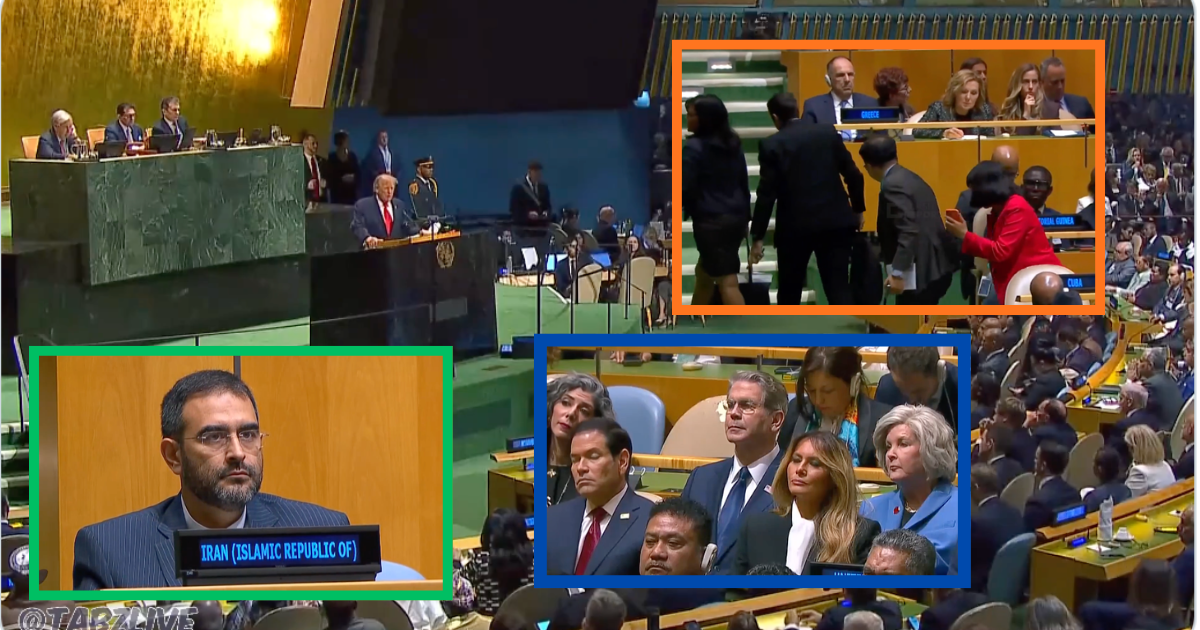
President Donald Trump used his address to the 81st United Nations General Assembly not only to outline U.S. foreign policy, but also to deliver a broader political message in the direct, confrontational style that has long defined his public appearances.
His 37-minute speech ranged from Iran and Cuba to U.S. military power, artificial intelligence and the role of international institutions. Reuters described the address as a presentation of Trump’s foreign-policy priorities, including support for the U.S.-Israeli campaign against Iran and a warning that Washington could escalate further if diplomacy fails.
A stark warning to Iran
One of the strongest moments came when Trump warned that the United States could “annihilate the Islamic Republic” if no agreement is reached to end the conflict.
The warning came even as diplomatic contacts continued in New York. Iranian officials have indicated that Tehran is still seeking a negotiated path on issues including the Strait of Hormuz and U.S. military pressure.
Iran’s delegation remained in New York as those contacts continued.
Cuba’s delegation walks out
Trump later turned his attention to Cuba, calling it a “failed state” and predicting political change on the island.
The Cuban delegation responded differently from Iran’s representatives: its members walked out of the General Assembly Hall in protest. Reuters video from the chamber showed the delegation leaving as Trump criticized Cuba’s government.
The moment created one of the more striking images from the speech — some delegations remained seated and listened, while Cuba chose to make its disagreement visible by leaving.
From diplomacy to political messaging
Trump’s address moved repeatedly between traditional foreign-policy themes and the kind of political language familiar from his domestic speeches.
He defended U.S. military actions, argued that American strength had reshaped several international conflicts, criticized governments he opposes and presented technological leadership — particularly artificial intelligence — as another arena in which the United States must remain dominant.
That gave the speech a tone that was both diplomatic and political.
Different delegations, different reactions
The response inside the hall reflected the divisions Trump was addressing.
Some representatives remained seated through his sharpest statements. Others, including the Cuban delegation, chose to leave.
Those contrasting reactions illustrated the unusual nature of the General Assembly: world leaders speak before nearly every government on the planet, including countries they openly criticize.
The audience is therefore not necessarily supportive — but it is global.
The UN as a political stage
The General Assembly is often associated with carefully negotiated diplomatic language, but it is also one of the world’s most visible political stages.
Leaders use it not only to explain policy, but to send messages to allies, rivals and domestic audiences at the same time.
Trump’s speech was a clear example of that dynamic: a foreign-policy address delivered in the language of political confrontation, before an audience whose reactions ranged from silent attention to open protest.
Sources: Reuters, Associated Press, United Nations
By NJ RADAR Team