


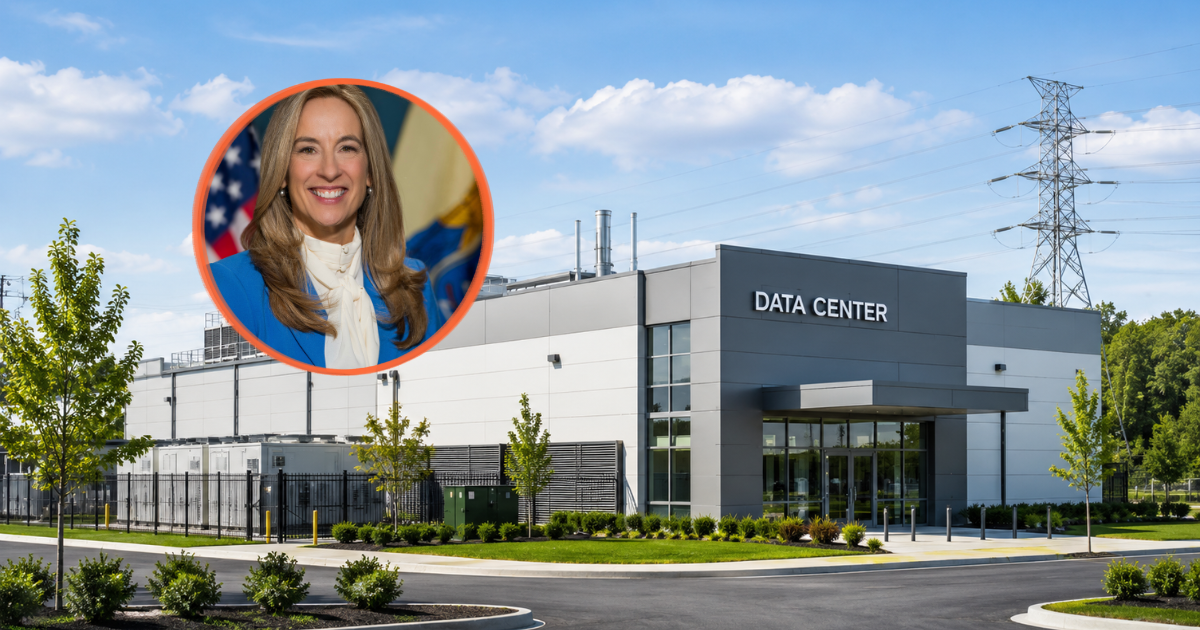
New Jersey Gov. Mikie Sherrill says decisions about new data centers should largely remain in the hands of local communities rather than be controlled by a statewide moratorium.
In an interview with POLITICO’s Energy podcast, Sherrill said some towns may decide that data centers are not appropriate at all, while others may conclude that such projects make sense depending on location, scale and local needs.
Local control instead of a statewide ban
Sherrill’s position comes as opposition to data center development grows across New Jersey. More than 90 municipalities have reportedly adopted some form of restriction, and lawmakers in Trenton have introduced more than a dozen bills dealing with data centers, including proposals for temporary moratoriums on larger projects.
Sherrill, however, has resisted a blanket statewide pause.
Her argument is that local governments should be able to decide whether they want a data center, whether they want to impose a moratorium, and what size of project they consider acceptable.
Data centers would face new state rules
At the same time, New Jersey is not leaving the issue entirely to municipalities.
Sherrill’s administration has already put in place a statewide framework requiring large data centers to shoulder more of their own energy costs, report their water and electricity consumption and negotiate community-benefit agreements with towns.
The state says those agreements can be used to secure local investments such as improvements to public infrastructure, schools, workforce programs and other community projects. Municipalities can also receive technical help from state agencies when negotiating with developers.
Sherrill has also emphasized that data centers should bring new clean-energy capacity online and contribute to the power grid instead of shifting the cost of their heavy electricity use onto other ratepayers.
Why data centers are becoming controversial
The rapid growth of artificial intelligence has sharply increased demand for data centers across the United States.
Supporters argue that the facilities can bring investment, tax revenue and construction jobs. Critics, however, point to their large electricity and water needs, possible noise and environmental effects, and concerns that ordinary residents could end up carrying part of the infrastructure cost.
Those concerns are increasingly visible across the country, where local resistance has become a significant political issue around new projects.
In New Jersey, recent local restrictions have often focused on energy use, water consumption, noise and quality-of-life concerns.
A town-by-town approach
Under Sherrill’s approach, New Jersey would establish statewide guardrails while leaving the final decision on individual projects largely to municipalities.
A town could reject data centers entirely, impose its own restrictions or negotiate with a developer for benefits in exchange for allowing a project to move forward.
The broader debate is therefore no longer simply whether New Jersey should have data centers. It is increasingly about where they should be built, how large they should be, who should pay for the infrastructure they require, and how much authority local communities should have over those decisions.
Sources: POLITICO Energy, Office of the Governor of New Jersey, NJEDA, New Jersey League of Municipalities, News 12 New Jersey
By NJ RADAR Team