


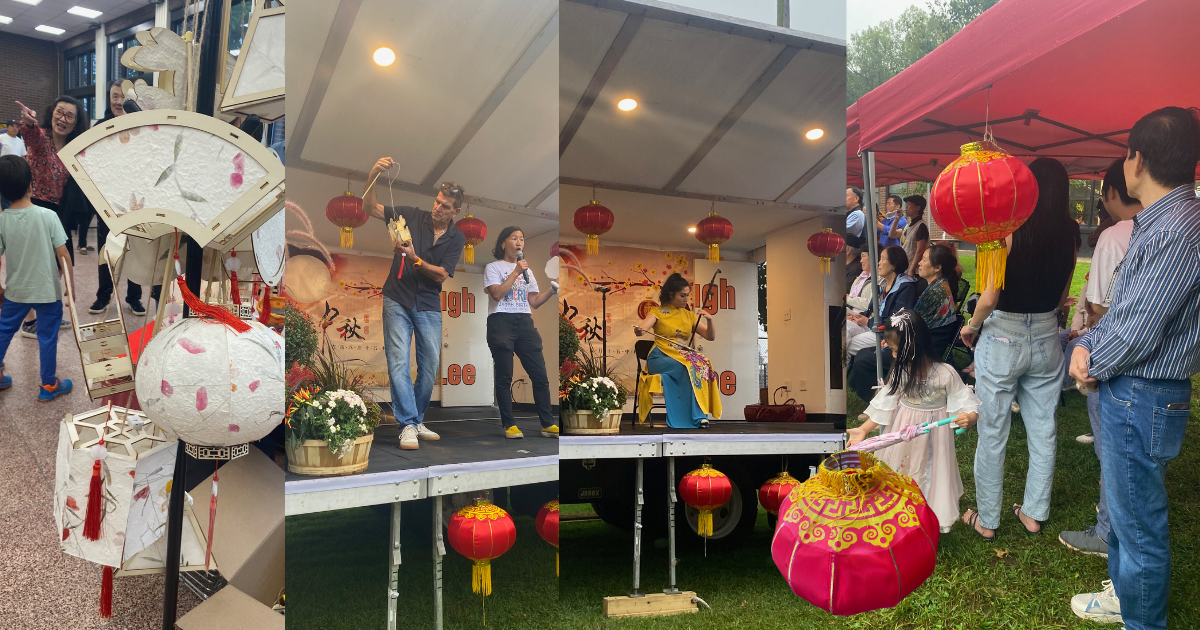
On Sunday, September 20, the Fort Lee Recreation Center was transformed for a few hours into a small window into Chinese culture.
Fort Lee’s Chinese American community organized its traditional Moon Festival, a celebration of the full moon, lanterns, family, and memory.
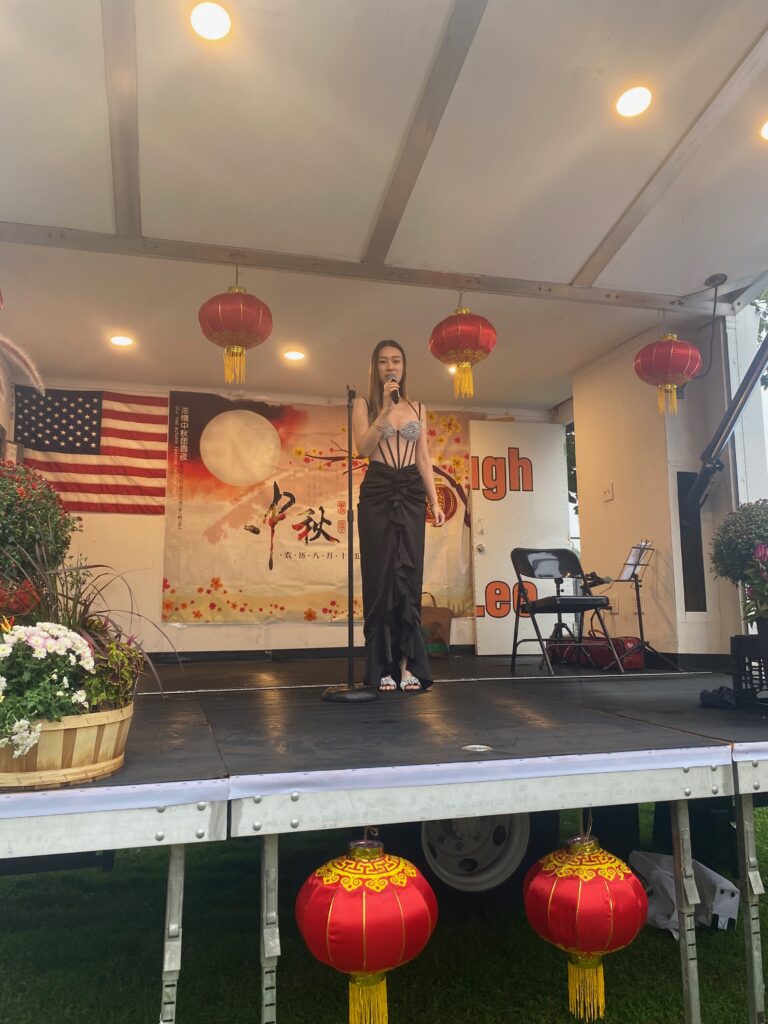
As food was being prepared — from mooncakes to grilled chicken — the gentle sounds of traditional Chinese string instruments filled the stage area. A woman dressed in a yellow qipao embroidered with blue flowers sang several songs while playing a Chinese stringed instrument resembling a guitar. I could not understand the words she was singing, but the melodies, together with the red lanterns hanging around the stage, brought the feeling of a distant China to Fort Lee.
The weather was humid, and several times it seemed as though rain was about to fall, but somehow it held off, almost as if it did not want to interrupt such a beautiful event.
Children sat around tables carefully assembling thin wooden frames. Inside, they placed translucent paper decorated with pressed leaves and flowers, then threaded string through the top. The small handmade lanterns were later sold, each one a little piece of light that someone could take home.
In another corner, children’s faces were being transformed into dragons, rabbits, flowers, and colorful characters. Face painting appeared to be one of the most popular activities of the day.
Mayor Mark Sokolich also arrived and addressed those gathered. He received his own lantern and spoke about his appreciation for events that bring the community together, adding a few words about Fort Lee’s Chinese community and its place in the town.
But behind all the colors, food, music, and lanterns stood an ancient story.
The story of Hou Yi and Chang’e.
According to one of the best-known versions of the legend, Hou Yi was the great archer who shot down nine suns to save the Earth from unbearable heat. Chang’e was the woman he loved.
When Hou Yi was given an elixir of immortality, he intended for them to share it. But fate took another course. Chang’e drank the elixir and rose to the moon, where she would remain separated from the man she loved.
And so, each autumn, when the moon is at its fullest and brightest, lanterns are raised toward the sky, carrying light into the darkness and keeping alive stories of love, separation, family, and remembrance.
That feeling was present in Fort Lee as well.
While parents bought mooncakes and children carried home the lanterns they had made, it was easy to imagine someone quietly looking toward the sky and thinking of those they love but cannot be with.
Perhaps that is part of the reason the Moon Festival has endured for so many generations: it reminds us that light can still travel across great distances, even when people are separated.
Overall, the Moon Festival brought joy not only to members of Fort Lee’s Chinese American community, but also to everyone who came to experience a part of their culture.
Through dance, songs, music, food, traditional clothing, and beautiful lanterns — including designs inspired by rabbits and butterflies — the Fort Lee Recreation Center became, for a few hours, a small window into a tradition that began far away but continues to live wherever people gather to celebrate it.