


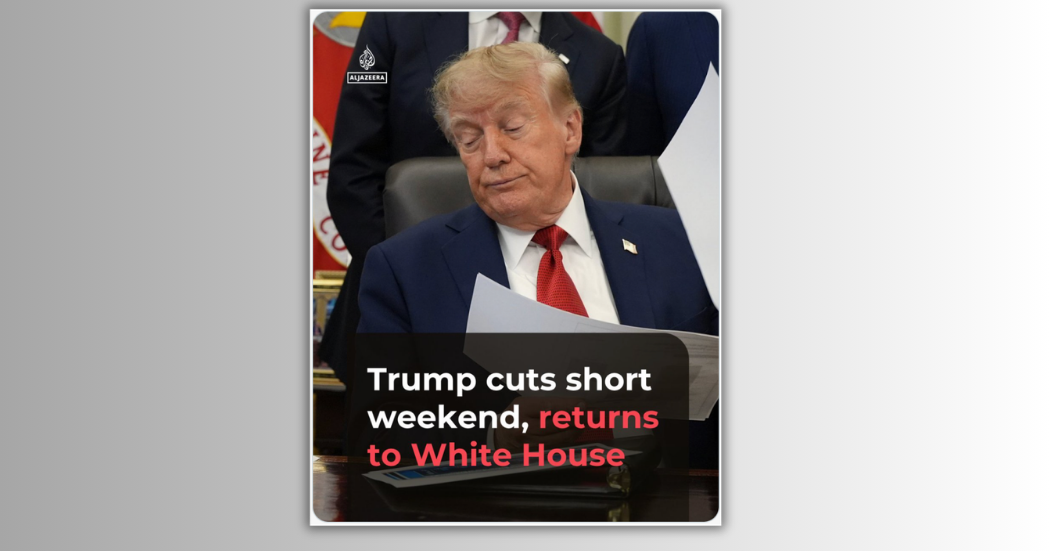
President Donald Trump unexpectedly cut short his weekend at Camp David on Saturday and returned to the White House a day earlier than previously scheduled, as tensions in the Middle East continued to rise.
The administration did not immediately explain why the president changed his plans. Trump had been expected to remain at Camp David, the presidential retreat in Maryland, until Sunday.
The timing of his return drew attention because it came on the same day Saudi Arabia reported a major new Houthi attack.
Saudi authorities said Yemen’s Houthi movement launched a ballistic missile toward Riyadh early Saturday. The Saudi-led coalition said the missile was intercepted, while residents reported hearing an explosion and seeing smoke near the capital’s international airport. Saudi officials said there were no reported casualties or damage from the missile strike on Riyadh.
The Houthis also claimed attacks on what they described as sensitive sites in Riyadh and on Saudi energy infrastructure, including facilities in Yanbu. Some of those claims have not been independently verified.
U.S. Issues New Security Warnings
As the situation developed, the U.S. State Department and several American embassies issued security alerts urging U.S. citizens across the region to exercise heightened vigilance.
The warnings cited the possibility of a rapid and unforeseen escalation in fighting involving Saudi Arabia and the Houthis. Americans in countries including Saudi Arabia, Bahrain, Qatar, Kuwait, Oman, Jordan, Lebanon, Iraq and Iran were advised to closely monitor security developments and follow instructions from local authorities.
The renewed alerts reflect growing concern that the Saudi-Houthi confrontation could spread beyond Yemen and threaten civilian infrastructure, airports, energy facilities and major shipping routes.
Fighting Has Intensified
The latest missile attack is part of a broader escalation that has intensified in recent weeks.
The Houthis have expanded military operations in Yemen and around the Red Sea, while Saudi Arabia has faced increasing pressure on its missile-defense capabilities. The fighting also threatens the Bab el-Mandeb Strait, one of the world’s most important maritime routes connecting the Red Sea with the Gulf of Aden and the wider Indian Ocean.
Any prolonged disruption in this area could affect global shipping and energy markets because commercial vessels and oil shipments regularly pass through the region.
Saudi Arabia has also sought additional defense support from regional and international partners as the confrontation has intensified. Turkey said Saturday that it could help meet Saudi military needs under a recently signed defense arrangement involving Turkey, Saudi Arabia and Pakistan.
No Official Link to Trump’s Return
Trump’s early return to Washington came amid these developments, but the White House has not said that the Middle East situation was the reason he left Camp David early.
That distinction is important.
The change in schedule and the regional escalation happened at the same time, but there is currently no official confirmation connecting the two events.
For now, what is known is that the president returned to the White House earlier than planned while the United States was issuing new security warnings and Saudi Arabia was responding to another Houthi missile attack.
With tensions already high across the region, the unexpected change in the president’s schedule is likely to keep attention focused on Washington for any further announcements.
Sources: Al Jazeera English; Associated Press; Reuters; AFP
By NJ RADAR Team