


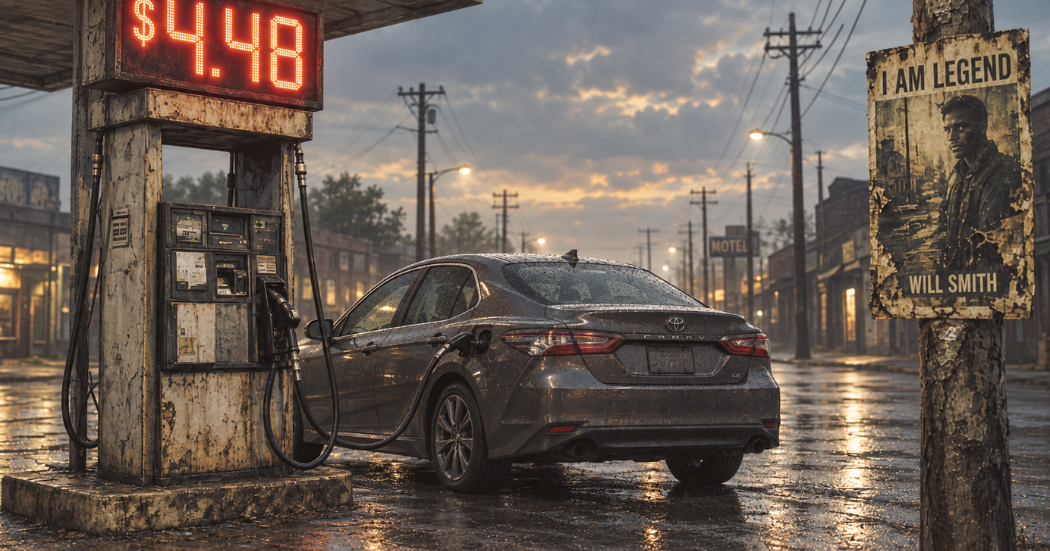
A meme currently circulating on social media compares today’s gasoline prices in the United States to a scene from the 2007 film I Am Legend, in which high fuel prices were part of a dystopian future. The comparison is meant as a joke, but the reality behind it is serious: fuel prices have been rising in recent months, along with the price of crude oil and mounting global tensions weighing on the energy market.
When I Am Legend hit theaters in 2007, the high gas prices seen in the film were just a small detail in a picture of a dystopian future. Now that detail has resurfaced on social media, only this time the comparison no longer seems entirely unrealistic.
American drivers are once again facing rising prices at the pump, and behind that lies a much bigger story: a sharp rise in crude oil prices, instability in the Middle East, problems with shipping routes, and a market that is increasingly sensitive to every new report of a possible supply disruption.
Gasoline: From About $2.90 to $4.48
According to AAA, the average price of a gallon of regular gasoline in the US was about $4.48 on September 19. A year ago it was about $3.19, so the gap is more than a dollar.
As recently as February 19, the national average was about $2.92. The US-Israeli war against Iran began on February 28, and by early April the average had topped $4 for the first time since 2022. It eased slightly over the summer ($4.06 on August 6, when oil had fallen to around $75 a barrel), but it has been climbing again since the start of September: $4.14 on September 3, $4.27 on September 10, and now about $4.48.
From $74 to Over $100 in a Few Weeks
The movement of US WTI crude best illustrates how quickly the situation has changed.
In early August the price fell to about $74.20 a barrel. A sharp rebound of roughly 16.6 percent followed, taking it to about $86.55 a barrel. In a short time, then, the price of a barrel rose by more than $12.
The rally continued. WTI closed at $96.05 on September 9, and AAA noted that crude had returned to around the $100 mark for the first time since July. Brent closed at $105.68 on September 14, and WTI at $101.39. Prices eased somewhat on Friday (Brent about $103.87, WTI about $100.30) but remain very high. Measured from the August low of $74.20, WTI is now about 35 percent more expensive.
And when crude gets more expensive, drivers sooner or later feel it at the pump. The price of gasoline doesn’t track crude oil day by day in lockstep, because refining, transport, taxes, and other costs all go into the final price, but crude is one of the most important inputs.
Why Has Oil Gotten More Expensive Again?
The main driver of the latest surge is not higher demand for gasoline. On the contrary, AAA says US demand has recently fallen, from 8.92 to 8.55 million barrels per day in weekly data. The problem lies mainly on the supply side and in geopolitics.
Drone attacks on Saudi energy infrastructure forced Saudi Arabia to shut down the East-West pipeline, which carries oil from the country’s eastern provinces to the Red Sea port of Yanbu. Its capacity is about seven million barrels per day, and since the start of the war it has served as the key bypass around the Strait of Hormuz. Reports suggest its closure could threaten up to 4% of the world’s oil supply. JPMorgan estimates that oil flows from the Middle East averaged about 17 million barrels per day over the past ten days, roughly six million below the 2025 average. Saudi output recently fell to its lowest level since 1990.
Most of the latest rise is tied to uncertainty over supply.
During August, tensions with Iran flared up again, and traffic through the Strait of Hormuz remained restricted. That is enough to make the market nervous, because a large share of the world’s energy trade passes through that waterway.
When there is a possibility that less oil will reach the market, buyers begin to price in a future shortage. Prices can then rise before an actual shortage ever occurs.
That is why the price of oil often moves on assessments as much as on facts: a single report of talks breaking down, a blocked shipping lane, or an attack on energy infrastructure can change the market very quickly.
The Strait of Hormuz Remains a Key Chokepoint
For years the Strait of Hormuz has been one of the most sensitive points in the global energy system.
Any serious disruption of traffic through it could have consequences far beyond the Middle East. That is why events in the region affect the price an American driver sees at the pump thousands of kilometers away.
A market analysis for September states that the US naval blockade continues to divert ships and restrict the flow of oil, further heightening nervousness in the market.
In other words, American gasoline doesn’t get more expensive only because of what happens inside the United States.
In a global market, an event in the Persian Gulf can end up as a few extra dollars on the receipt when someone in New Jersey fills up the tank.
The Market Calmed Somewhat on Friday
There are also signs of relief. Over the past six days, Saudi Arabia moved about 2.8 million barrels per day through the Strait of Hormuz, compared with just 700,000 in August, and it is selling some oil through ship-to-ship transfers outside the strait. Aramco expects it could restore at least part of the flow through the damaged pipeline within days.
The danger has not passed, however: only four commercial vessels were detected passing through Hormuz on Thursday.
US Strategic Reserves at Their Lowest Level in More Than Four Decades
One more data point makes the current situation especially notable.
US strategic oil reserves fell below 300 million barrels in early August, for the first time since 1983. Before the war they held about 415 million barrels, and in March Washington authorized the release of 172 million barrels to ease supply disruptions.
Strategic reserves exist precisely as a safety net during major supply disruptions. When they are lower, there is less room to cushion the effects of a crisis.
That doesn’t mean the US will run out of oil. But it does mean the market may react more strongly to a new threat than when reserves were much larger.
OPEC+ Tries to Boost Supply
There is also a factor that could work in the opposite direction.
OPEC+ agreed to raise its production quotas for September by about 188,000 barrels per day, continuing to gradually increase the amount of oil reaching the market. According to reports, those increases have largely remained on paper, because wars have disrupted exports from the Persian Gulf, Russia, and Kazakhstan.
More oil on the market usually eases pressure on prices.
The problem is that in the current situation the market is looking at two entirely different things at once: additional production on one hand, and on the other the risk that war, blockades, or attacks could suddenly take much larger volumes of oil off the market. That is why prices remain volatile.
Another Source of Pressure: Russia and Ukraine
The war in Ukraine has not disappeared from the energy equation either.
Attacks on Russian refineries and Russian strikes on Ukrainian energy infrastructure continue to affect fuel availability and add pressure on the global energy market.
Add to that the problems tied to Iran and the Middle East, and it becomes clear why the market is reacting so nervously.
This is not about a single event, but about several different sources of risk appearing at the same time.
From the Exchange to the Gas Pump
For the average driver, all this talk of barrels, sea lanes, and OPEC comes down to a very simple result.
Higher crude prices raise refiners’ costs. Higher refining and transport costs are then gradually passed on to wholesale fuel prices, and eventually to gas stations.
That is why a rise in oil prices that begins this week may not be fully visible at the pump the same day. The effect arrives gradually.
And the reverse is also true: even when oil starts getting cheaper, drivers sometimes have to wait for it to be fully reflected in retail prices.
So Where Does I Am Legend Come In?
Which brings us back to the film.
The post now spreading on social media compares today’s fuel prices with those shown in I Am Legend.
Of course, this is above all the internet doing what it does best: finding an odd parallel between fiction and reality.
Today’s America is not the post-apocalyptic world of the film, and high gas prices don’t mean the movie’s dystopia has come true.
But the comparison has become popular precisely because it touches on something people feel every day.
Prices at the pump are one of those economic things you don’t need to follow on the stock exchange to notice. You see them in big numbers as you drive down the street. You see them when you put your card in the pump. You see them when you have to decide how much to fill the tank.
What Next?
The direction of prices will depend largely on whether the geopolitical situation calms down or gets worse.
If supply stabilizes, negotiations progress, and additional OPEC+ output reaches the market, pressure on prices could ease. A quick return of the Saudi pipeline to service, which Aramco is hoping for within days, would help as well.
If there is a new escalation, especially one that seriously threatens transport through the Strait of Hormuz or other key routes, prices could quickly react again. President Trump recently said the US could re-escalate attacks on Iran, and talks between the Gulf states and Iran in Oman have been postponed. The market analysis cites new supply disruptions as one of the main risks for September.
For American drivers, it all comes down to a much simpler question than any market analysis: how much will the next tank cost?
And perhaps that is why a scene from a film made almost two decades ago is circulating on the internet again. What once looked like a detail from a dystopian future has become a joke that drivers understand a little better than they would like.
In Place of a Conclusion
The rise in oil and fuel prices in recent months is not the result of a single event, but of several overlapping risks: the war with Iran, restricted flow through the Strait of Hormuz, attacks on the Saudi pipeline, low US strategic reserves, and the continuing war in Ukraine. The market is currently pricing risk more than actual supply. That is why the I Am Legend meme resonates: not because America is heading into a post-apocalyptic scenario, but because high prices at the pump are no longer the exception, but part of a new, unstable normal.
Sources: AAA Fuel Prices — Current U.S. gas prices; AAA — National Average Jumps 13 Cents in One Week; Reuters — Oil slides after China asks Iran to limit Houthi attacks on Saudi oil facilities; Reuters — Oil falls as investors watch Middle East supply disruptions; Kapital RS — market analysis provided for September 2026.
[…] According to AAA, the average price of diesel in New Jersey stood at approximately $6.38 per gallon on October 1, compared with about $3.61 one year earlier — an increase of roughly 77%. […]